


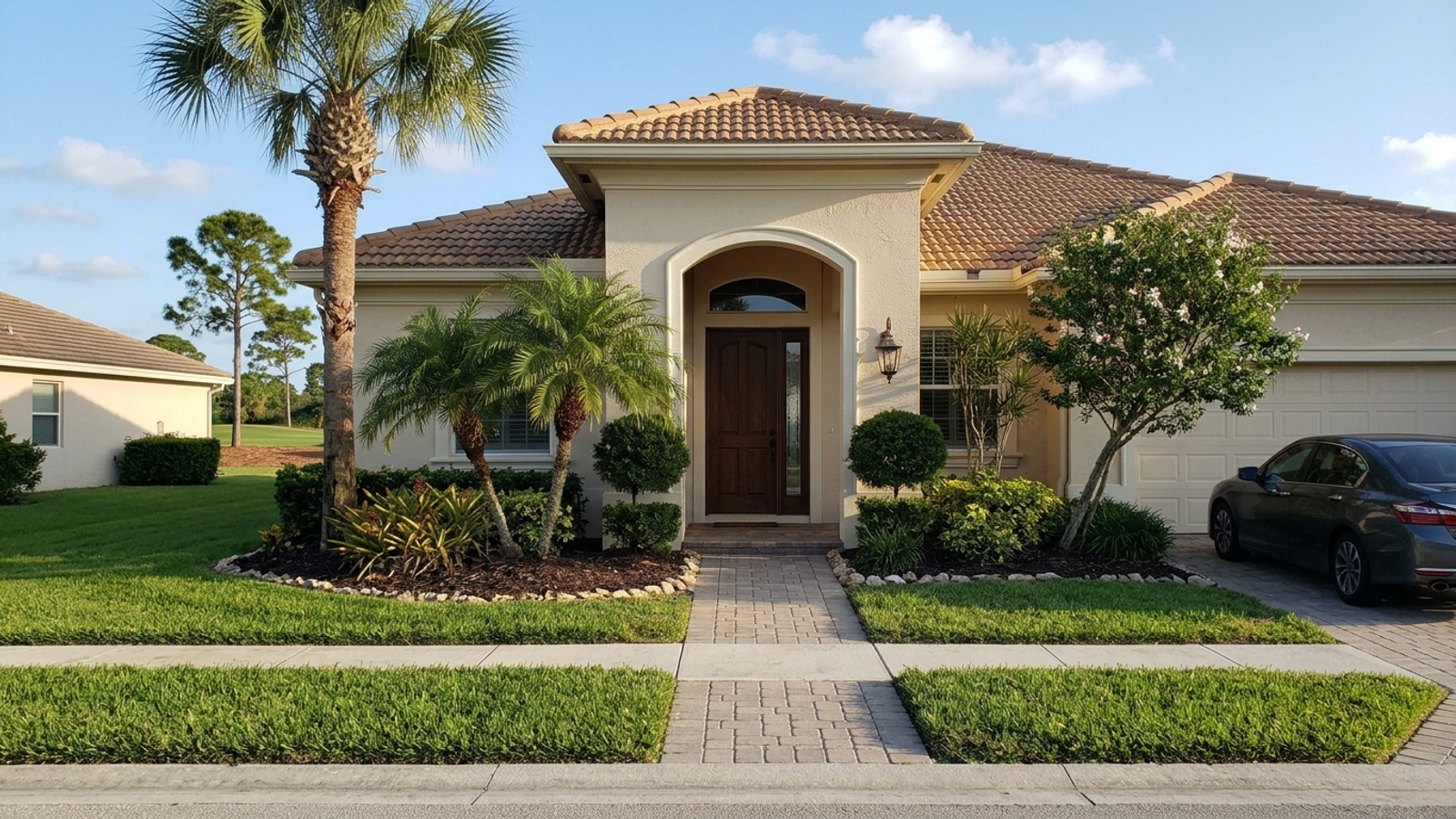
The median home price across all of PGA Village, FL recently sat around $440,000, but buyers looking at the top end of the market face a different set of numbers. The upper tier here is defined by golf course frontage, private enclaves, and newer construction phases that push prices well past that baseline.
If you want to buy into these premium pockets, a few basic questions need answers first. Do you want to live on the course, or just near it? Does a separate enclave setting matter more to you than a fairway view? Do you want newer construction or are you fine with resale? And is your budget closer to the townhouse median or the single-family median? The answers shape everything else.
Key Takeaway
The top of PGA Village's market is single-family homes, and the pockets to start with are the golf-frontage homes on the PGA Golf Club courses and enclaves such as Island Club. Those homes are also where you have the most room to bargain right now, as only about 9% of single-family homes sold over asking recently. If you prefer to pay less to get in, townhouses cost less, but they are the tighter, rising segment.
Who This Guide Is For
You are shopping the upper end of PGA Village and deciding which golf or enclave pocket is worth its premium, and how hard you can negotiate on it right now.
Where PGA Village Home Prices Are Highest
In PGA Village, the expensive end is the negotiable end. Single-family homes, where every top-priced pocket sits, recently showed roughly 5.3 months of supply with prices down about 2.9% year over year. That supply level gives you real room to ask for concessions or negotiate on price. Townhouses are the cheaper entry point, but they're up 4.4% with only 2.3 months of supply, so expect sellers there to hold firmer.
The single-family premium mostly buys space rather than a completely different location. The median price for a single-family house runs about 33% higher than a townhouse, yet the price per square foot is only about 8% higher: roughly $223 versus $206. Most of that step up in price goes directly into square footage, not some exclusive geography.
One number worth treating carefully is the all-homes median, which fell about 6.1%. That's a bigger drop than either property type posted individually, and the reason is simple: the mix of what sold shifted. Don't read it as a flat 6% discount on any specific house.
Townhouses have their own wrinkle. They sit on the market longer, with a median of 143 days, yet they still close at over 98% of list price. Sellers are patient and not panicking. Because property data feeds don't break out prices by specific enclave, the pocket rankings below rely on county sales records, but you can check our housing market trends page for more detail on these shifts.
Golf Course Frontage Areas in PGA Village
Frontage data shows a premium for fairway lots over interior streets: you pay for the longer sight lines and the resale appeal that comes with the setting. Local appraisal data can show you exactly how much those frontage lots command over interior streets.
The trade-off is that you live with daily golf traffic right outside your door. Players throughout the day, early morning maintenance equipment: that's the package. If you want to be directly on the course, two main options exist depending on which layout suits you.
Homes on the Dye Course
The Dye Course at PGA Golf Club in Port St. Lucie was built in 2000 and designed by Pete Dye. Homes along this layout carry weight because of the designer's reputation and the challenge the course presents. The frontage offers long sight lines and strong resale appeal for buyers who want to be immersed in the golf environment.
The downside is straightforward: frontage on a course selling public tee times means a steady flow of outside golfers past your lanai. Visit a course-frontage home early in the morning and on a weekend afternoon to judge play traffic and mowing noise before you write an offer. You can also read our Dye Course guide for more details on the layout.
Homes on the Wanamaker and Ryder Courses
For buyers who want a course view but find Dye-side listings thin, the Wanamaker and Ryder courses are a strong alternative. Both were designed by Tom Fazio, who was hired in the mid-1990s to design the two championship courses at this flagship PGA of America property. These homes carry the same kind of view premium, with a different character and design style than the Dye.
What you give up is certainty about your view year-round. Course renovations or maintenance closures can change sight lines and noise levels for a season. Ask the club for its current and planned maintenance or renovation schedule for the specific holes behind any home you're considering before you make an offer.
Enclaves and Newer Neighborhoods in PGA Village
Not every buyer wants to live directly on the fairway. For many, the premium goes toward a separate enclave setting or a newer build. These pockets offer a different lifestyle, one focused on privacy, updated construction, or specific neighborhood amenities rather than a golf view. You can check the best neighborhoods in PGA Village to see which of these settings fits your search.
The trade-off is usually an extra layer of costs. Buying into a separate enclave or a newer subdivision often means taking on a sub-association fee or a special tax assessment. You have to weigh the updated finishes and quieter streets against higher monthly carrying costs before the comparison with a standard street makes sense.
Island Club
When buyers talk about the expensive part of PGA Village, they often mean Island Club. This neighborhood stands apart physically, with its own entry and specific lot types that hold value well. The setting provides a genuine sense of separation from the broader master-planned community.
The downside is that an enclave usually means a sub-association whose dues stack on top of the master association fees. Get the current dues at both levels and what each covers before you compare an Island Club property with anything on a non-enclave street. Our Island Club guide has full details on the neighborhood.
Glynlea
Glynlea appeals to resale buyers who want a quieter pocket with a specific style of housing stock. The homes here reflect an earlier construction era in the community, with established streetscapes and a settled feel. It's a solid option if you prefer that over brand-new construction.
What you give up is the condition of newer systems. Homes from an earlier build era can carry roof and system ages that affect your insurance rates and near-term maintenance costs. Ask the seller for the roof installation date and permit history before you get too far into the process.
PGA Village Verano
PGA Village Verano is an all-ages community built by Kolter Homes, and it's where you go if newer construction is the priority. Less deferred maintenance, modern floor plans, updated building codes: that's the case for buying here over an older resale.
The catch is the tax structure. Newer Florida master-planned communities often carry a Community Development District assessment on the property tax bill. Ask for the most recent tax bill and look for a non-ad valorem CDD assessment line before you compare Verano with an older resale. Our PGA Village versus Verano page compares clubhouses, and our new developments page covers more options if you want to browse further.
What Makes a PGA Village Home More Expensive
Several specific features push a PGA Village house into the top pricing tier. Course frontage or a wide water view is the biggest driver, commanding a premium over standard interior lots. A private enclave entry adds to the price tag as well. After those two, newer construction and larger lot sizes round out the main drivers: a home built in the last few years will list higher than an original build from the early 2000s at a similar size.
Club memberships and association dues raise your true carrying cost without adding anything to the actual sale price. Factor those in early. Current pricing is on our golf rates page, standard community charges are on our association fees page, and our new home developments page covers the latest builds if you're leaning newer.
How to Buy at the Top of the PGA Village Market
Buying at the top of this market requires looking past the list price. Two upper-tier homes offered at the exact same price can differ widely in their actual yearly cost once you account for memberships, master and sub-association dues, any development district assessments, and property taxes. Nail down the total carrying cost before you fall for a specific house.
Once you have that number, you can use current market data to shape your negotiation. The top end of the market plays by different supply and demand rules than entry-level townhouses.
Price the Club and Fees Before the House
Community fees in a master-planned golf community add up quickly. Calculate their full weight early. You can find current details on our golf rates, association fees, and property taxes pages.
Membership terms and dues can change after you close. Get the current golf membership agreement, including initiation and annual dues, in writing from the club. Get the association's latest budget in writing before your inspection period ends. Both of those are standard asks, and any seller should hand them over without hesitation.
Use the Sale-to-List Gap to Set Your Offer
Single-family homes recently sold at a median of 97.5% of their list price. On a hypothetical $600,000 listing, the typical close would be about $585,000, roughly $15,000 below asking. With only a small share of homes selling above list price, starting below asking and asking for closing-cost help is a reasonable approach. You can read more about that on our buyer closing costs page.
A well-priced course-view home can still draw full price, so that median does not apply equally to every listing. Check how long the home has been listed and look at its price-change history before you write the offer. That context tells you more than the market-wide statistic does.
Check Insurance and Roof Age Before You Commit
An insurance quote can swing the monthly cost of an upper-tier home by more than a few thousand dollars a year. Get a quote early in the process and check the property's flood zone on the FEMA Flood Map Service Center. Our weather and storm preparation page covers local climate factors worth knowing.
On older resale homes, a high premium on an aging roof can wipe out whatever discount you negotiated on the purchase price. Get a binding homeowners insurance quote before your inspection period ends. If you need help comparing the true costs of two different properties, reach out and we can run the numbers together.
At a Glance
- Median sale price, all homes: $439,866, down 6.1% year over year (338 sales; 90 days ending 2026-09-30)
- Median sale price, single-family: $459,884, down 2.9% year over year (299 sales; 90 days ending 2026-09-30)
- Median sale price, townhouses: $346,500, up 4.4% year over year (35 sales; 90 days ending 2026-09-30)
- Median price per square foot: $223 single-family, $206 townhouses, $217 all homes (90 days ending 2026-09-30)
- Months of supply: 5.3 single-family, 2.3 townhouses, 5 all homes (90 days ending 2026-09-30)
- Median days on market: 108 single-family, 143 townhouses, 109 all homes (90 days ending 2026-09-30)
- Sale-to-list price: 97.5% single-family, 98.3% townhouses, 97.6% all homes (90 days ending 2026-09-30)
- Share sold above list: 9.2% single-family, 5.9% townhouses, 8.8% all homes (90 days ending 2026-09-30)
- Homes for sale: 520 single-family, 27 townhouses, 547 all homes (90 days ending 2026-09-30)
Most Expensive Areas in PGA Village FAQs
Is PGA Village the Most Expensive Part of Port St. Lucie?
It depends on the specific neighborhood. The median sale price for all homes in PGA Village is roughly $440,000, but you should check current city-wide data to see how that compares to the rest of Port St. Lucie. Gated communities elsewhere in the city, such as Tesoro, are often cited as pricier depending on recent sales.
Is PGA Village Verano a 55+ Community?
No. Only its gated sub-neighborhood, Cresswind at PGA Village Verano, is age-restricted to 55+ residents. Buyers in the broader Verano sections face no age requirement, but you can check our retirement communities page for age-restricted options.
Where Is PGA Village Verano in Relation to PGA Village?
PGA Village Verano is not a distant location; it sits immediately next to and within the larger PGA Village development. Residents have direct golf-cart access to the PGA Golf Club rather than having to drive miles away. You can review our commute times page for more details on getting around the area.
Is the PGA Golf Club Open to the Public?
Yes, the club allows public play with specific booking windows. On the Ryder Course, tee times from November through April can only be booked two days in advance by the public, while PGA Professionals and their guests can book 60 days out. Check our golf rates page for current pricing.
Do You Have to Join the Golf Club to Buy a Home in PGA Village?
No, golf memberships at the PGA Golf Club are optional for all residents. Homeowners can access community pools, fitness centers, and clubhouses through standard association fees without purchasing a golf membership. You should confirm membership terms on any specific listing with the club to be sure.
Does PGA Village Have CDD Fees?
The older, original PGA Village neighborhoods do not carry a Community Development District fee. Only the newer Verano section of the development carries a CDD assessment, which appears as a line item on the St. Lucie County property tax bill rather than as a monthly charge. Look for the non-ad valorem line on the seller's latest tax bill to verify.
How Long Do Single-Family Homes in PGA Village Take to Sell?
Single-family homes in PGA Village recently spent a median of 108 days on the market. For a buyer, this means you generally have time to negotiate, while sellers should prepare for a multi-month listing period. You can read our time to sell page for more context on these timelines.
Is PGA Village Part of the City of Port St. Lucie?
PGA Village carries the 34986 ZIP code and is home to the PGA Golf Club, but it is not technically inside the city limits. The community's own resident handbook states that PGA Village is located in unincorporated St. Lucie County. You can read our history page to learn more about the area's development.
Sources