


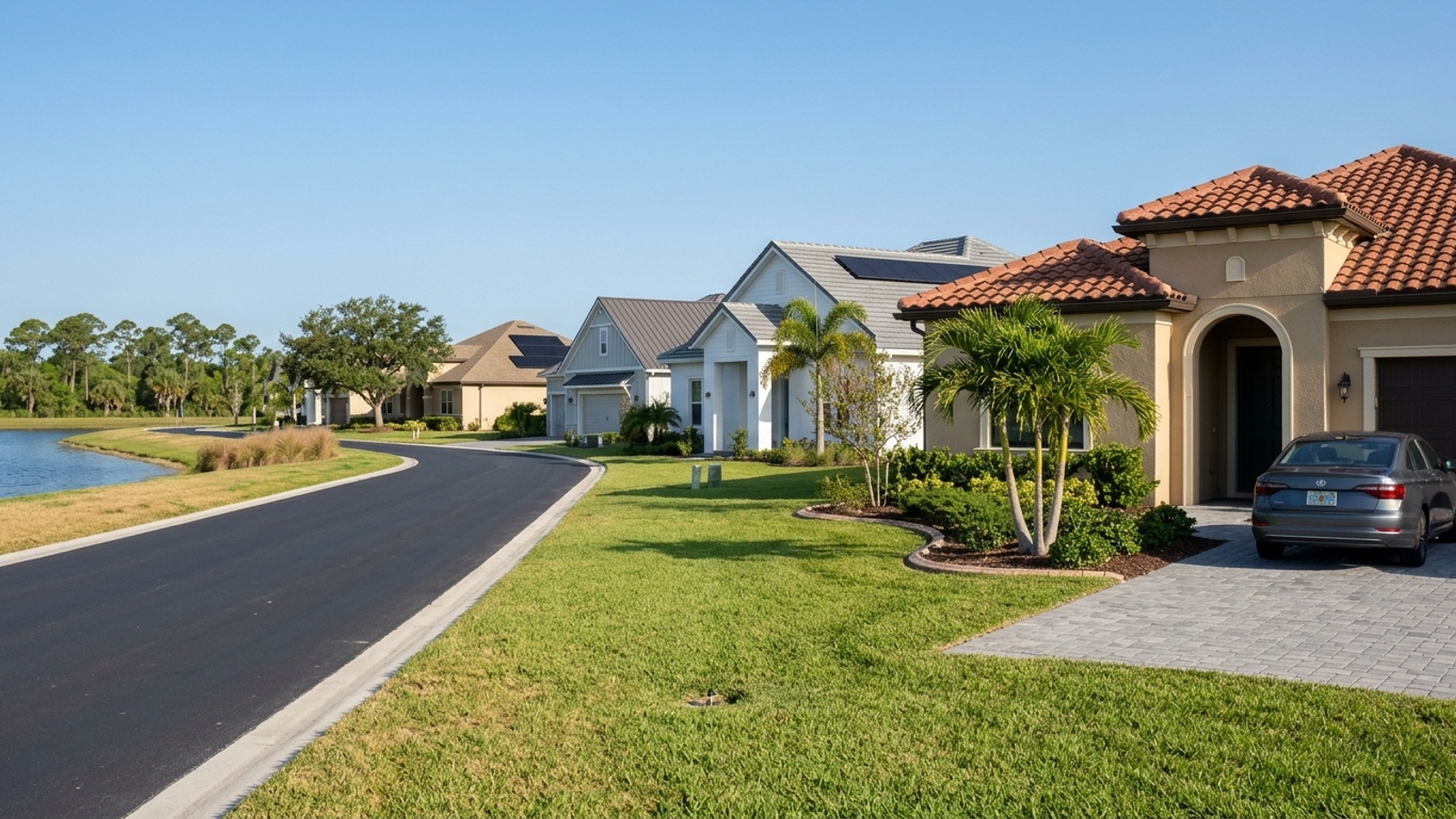
Buyers looking at Riverland homes in Port St. Lucie, FL, face a median sale price of around $517,000. Beyond the mortgage, monthly carrying costs are shaped by how local utility services are structured and billed.
Some services arrive as direct monthly bills, while others are folded into community fees or annual taxes. A clear list of who provides what and how it gets billed lets you build an accurate budget before making an offer.
Key Takeaway
Most Riverland homes run on FPL for electricity and Port St. Lucie city utilities for water and sewer, so rates won't differ much between homes you compare. What does differ is what each community folds into HOA dues and CDD assessments, making it worth comparing those breakdowns first. With 5.4 months of supply in the latest 90-day window, you have room to ask for a year of the seller's bills before you sign. If a seller declines to share them, use the FPL benchmark bill in the FAQ section as your floor.
Who This Guide Is For
You're weighing a home in Riverland and want to know which utility bills you'll pay, who sends them, and what they'll add to your monthly costs before you make an offer.
How Utility Bills Work in Riverland
The electric and water rates you'll pay are set by FPL and the city, and they don't vary home to home. What does vary is what each community bundles into HOA dues and CDD assessments.
For the bigger picture, see Pros and Cons of Living in Riverland, Port St. Lucie.
With homes taking a median 88 days to sell, you have the time to get a year of the seller's bills and a full breakdown in writing before you commit. The bills themselves arrive three different ways, and sorting that out early makes it much easier to track your fixed versus variable expenses.
Bills You Set Up in Your Own Name
Electricity and water/sewer are the accounts you open personally. They're usage-driven and fluctuate month to month, and you'll need to contact the providers directly to establish service.
Start dates and deposits are entirely your responsibility. A missed transfer can mean arriving to a home with no water or power on move-in day, which is a preventable problem.
Services Paid Through HOA Dues
Some services, often common-area utilities and sometimes lawn irrigation or bulk internet, are paid inside your dues. That shifts them from variable to fixed costs. Ask the HOA for a written list of what's included, the provider for each service, and the contract end dates.
You can read more about what each Valencia neighborhood covers in our guide on HOA fees. The tradeoff is flexibility: you pay for bundled services whether you use them or not, and the bundle can shift when the HOA adopts its annual budget.
Charges on Your Property Tax Bill
Certain local costs show up on your St. Lucie County tax bill rather than as monthly statements. CDD assessments in Riverland fund community infrastructure and appear there on an annual basis. The city also levies a stormwater management non-ad valorem assessment, which sits at $195 per unit for 2026.
Our guide to property taxes walks through the math. Because these lines flow into your mortgage escrow, comparing only HOA dues can cause you to underestimate your actual monthly payment, and a CDD's debt portion can run for years.
Which Utility Costs to Check First
If predictable monthly costs matter to you, start with homes in communities whose HOA bundles internet and irrigation. Those services move from usage-based bills into fixed dues, leaving electricity and household water as the main swing items.
Does the community's HOA bundle internet, TV, or irrigation? If yes, read "Services paid through HOA dues" and "Internet, TV and phone" before budgeting. If no, plan for those under "Bills you set up in your own name."
Does the home have a pool, a large lawn, or a water softener? If yes, go to "What runs utility bills up in Riverland" and "Irrigation and reclaimed water," because those drive the biggest swings. Do you need gas for a range, water heater, or generator? Confirm a gas meter at the address before touring further, because adding gas to an all-electric home is a project with its own cost and HOA approval, not a simple swap.
Are you closing within 30 days? Jump to "Plan the move-in transfer dates" so accounts and deposits are handled before keys change hands. If you're comparing two finalists on total carrying cost, start with the non-ad valorem lines on each home's latest tax bill. CDD and city assessments land in escrow and can differ by community even when HOA dues look identical.
Utility Providers Serving Riverland
Port St. Lucie is FPL territory, while neighboring Fort Pierce runs its own city-owned utility. Some providers here are municipal; others are private companies operating under franchise agreements. The entity handling each service dictates exactly who to call.
Here's the breakdown of who supplies what to a typical Riverland address.
Electricity
Florida Power & Light (FPL) provides electricity to Riverland homes, and there's no alternative provider to shop. Air conditioning is the largest variable cost in a single-family home here. Our guide on local weather covers how summer heat affects cooling loads.
If you want a realistic summer electric number before you make an offer, start with the seller's June through September FPL history. Summer bills can run well above winter ones, and since you can't switch providers, the only levers are the home itself: AC age, insulation, and set points.
Water and Sewer
The Port St. Lucie Utility Systems Department handles water and sewer service for the area, using a base-charge-plus-usage structure. The sewer charge ties directly to metered water, which matters more than it might seem: water that never goes down a drain can still be billed as sewer if it runs through the house meter.
Confirm with the city utility that the address falls inside its service area. If irrigation runs through the house meter instead of a separate source, every watering cycle raises both the water and the sewer line. Ask the seller which meter the sprinklers use before you sign anything.
Irrigation and Reclaimed Water
Lawn watering systems vary by street and neighborhood within the master plan. Some homes pull from a community irrigation source; others rely on the municipal supply. When irrigation is community-run, the cost typically sits in your dues or the CDD rather than on your personal water bill.
The tradeoff with a community-run system is that you don't control the schedule or fix the zones yourself. Dry spring months can leave lawns stressed within the allowed rules.
Trash and Recycling
In Port St. Lucie, residential trash collection is billed once a year on the property tax bill rather than monthly. For the fiscal year beginning October 1, 2026, the city imposed an annual solid waste non-ad valorem assessment of $482.16 per dwelling unit. This covers garbage, recycling, and yard waste collected by FCC Environmental Services, LLC.
Ask the HOA about rules on cart storage. Because it's on the tax bill, the charge is easy to miss when you're budgeting monthly costs, and pickup days and bulk-item rules are set by the city's contract.
Natural Gas
Whether natural gas is available depends entirely on the street and on what the builder installed. The safest default is to assume a home is all-electric unless a gas meter is visibly present. Our guide on new home developments covers typical builder options.
Confirm whether a natural gas meter serves the address before planning gas appliances. If the home isn't plumbed for gas, adding a gas range, tankless heater, or whole-home generator becomes a project with its own cost and HOA approval.
Internet, TV and Phone
Some Riverland communities contract one provider for every home and bill it through HOA dues. Ask the HOA how bulk internet or TV service is activated for a new owner and what speed tier is included.
With a bulk contract, you keep paying for the bundled service even if you'd prefer another provider, and upgrades above the included tier cost extra.
How Much Utilities Cost in a Riverland Home
A monthly utility budget combines both fixed charges and estimated usage. Home size directly affects cooling and water demands, and both scale with square footage.
Below is a look at how those costs scale for a typical property. Every usage number is hypothetical, and personal habits drive the final total.
A Typical Cost Breakdown by Home Size
For a home near the median sale price, your fixed utility costs include any HOA-bundled services and the annual tax-bill charges divided by 12. Water and sewer bills combine a base charge plus usage, such as an estimated 4,000 gallons billed at the city's Block 1 rate of $5.05 per 1,000 gallons for water and $8.27 per 1,000 gallons for wastewater.
Electricity scales with the size of the house. At a median price per square foot of $288, each extra 100 square feet costs roughly $28,800 at purchase and also adds cooling load. A hypothetical summer month will push your bill well above the standard FPL benchmark. Any model is only as good as the usage you plug in, and the seller's actual bills beat an estimate every time.
What Runs Utility Bills Up in Riverland
The usual drivers in a detached Florida home include AC set points, older cooling units, pool pumps, and water softener regeneration cycles. Irrigation leaks are another common culprit that can quickly inflate a water bill.
One practical check: turn off all water inside the home and watch the meter outside to see if it keeps moving. Irrigation line leaks are often underground and invisible, so the first sign is usually a bill, not a puddle.
What to Ask Before Buying a Riverland Home
The current market gives you time to gather utility facts before finalizing a purchase. Values fell 7.7% year over year in the 90 days ending in September 2026, which gives you room to negotiate if a home requires unexpected utility upgrades.
An early document request prevents surprises during closing. Here's what to ask for while you're still evaluating the property.
Ask for 12 Months of Utility Bills
With a median 88 days on market, a request for a year of FPL and water bills is reasonable. It also gives you grounds to ask for a credit if the bills reveal an aging AC or a leak. Focus on summer months for AC costs and dry spring months for irrigation usage.
Ask the seller whether the home was occupied year-round. A seasonal or vacant home's bills understate year-round use, so check occupancy before trusting low numbers.
Get the HOA and CDD Breakdown in Writing
Request the HOA's list of included services with contract end dates, and pull the latest tax bill to see the CDD and non-ad valorem lines. Look up the home's latest tax bill on the St. Lucie County Tax Collector site and note every charge. A surprise in either document is grounds to renegotiate rather than walk away.
Our seller disclosures guide covers what owners are required to provide. HOA estoppel letters often arrive late in escrow, so request the services list at the offer stage, not at closing.
Plan the Move-In Transfer Dates
Open FPL and city water accounts in your name for the closing date. FPL requires the service address and a preferred start date, and they typically connect service the same day if the order is received by noon. Confirm with the HOA how bulk internet is activated for a new owner.
Our moving guide has broader timing advice. Utility deposits add to the cash needed at move-in on top of closing costs, and any gap between the seller's shutoff and your start date is yours to prevent.
At a Glance
- Median sale price, all homes (90 days ending 2026-09-30): $517,005
- Median sale price, single-family homes (90 days ending 2026-09-30): $517,064
- Year-over-year change in median sale price, all homes (90 days ending 2026-09-30): -7.7%
- Homes sold, all homes (90 days ending 2026-09-30): 41, all of them single-family
- Median days on market, all homes (90 days ending 2026-09-30): 88
- Sale-to-list ratio, all homes (90 days ending 2026-09-30): 97.3%
- Share sold above list price, all homes (90 days ending 2026-09-30): 5%
- Months of supply, all homes (90 days ending 2026-09-30): 5.4
- Homes for sale (inventory), all homes (90 days ending 2026-09-30): 71
- Median price per square foot, all homes (90 days ending 2026-09-30): $288
Riverland Utilities FAQs
What Is the Average Electric Bill in a Riverland Home?
For 2026, FPL's typical 1,000-kWh residential customer bill in most of Florida increased to $136.64 per month. This is a benchmark, not a Riverland average, and single-family homes with whole-home AC often use more in the summer. Ask the seller for 12 months of bills to get the real number for that specific home.
How Do I Find Out Which Utility Companies Serve a Riverland Address?
You can check the Port St. Lucie Utility Systems Department's service area, which covers more than 120 square miles including Riverland. For electricity, St. Lucie County confirms FPL is the local utility company for the Port St. Lucie area. Ask the HOA which services are bundled into your dues.
What Is the Customer Service Phone Number for Port St. Lucie Utilities?
The City of Port St. Lucie Utility Systems Department's customer service and billing contact number is (772) 873-6400. Their administration and field operations are available 24 hours a day, 365 days a year.
Do Riverland Homes Have Well Water or City Water?
Most Riverland homes connect to city water, as the development falls inside the Port St. Lucie Utility Systems Department's service area. Private wells are permitted by the Florida Department of Health in St. Lucie County specifically in areas outside that piped utility service area. Check the seller's disclosure to confirm the exact water source for drinking and irrigation.
Is the Tap Water in Riverland Safe to Drink?
The City of Port St. Lucie Utility Systems Department publishes an annual Water Quality Report. The 2026 edition confirms the water continues to meet all federal and state requirements. Read the city's latest annual drinking water quality report rather than relying on vendor claims, and note that whole-home filtration is a personal choice, not a requirement.
How Much Is the Deposit to Start Water Service in Port St. Lucie?
A specific residential new-account deposit dollar amount is not stated on the official city contact page. You'll need to call the Utility Systems Department at (772) 873-6400 to find out the required deposit and any account setup fee for your address. Ask the representative whether the deposit is refundable.
When Can I Water My Lawn in Riverland?
For unincorporated St. Lucie County, odd-numbered addresses may water Wednesdays and Saturdays, while even-numbered addresses water Thursdays and Sundays, always before 10 a.m. or after 4 p.m. Since Riverland is inside city limits, it may be governed by a separate city ordinance or a three-day-a-week option. If irrigation is community-run, the HOA sets the schedule within those rules.
What's the Cost of Living in Riverland, Port St. Lucie?
Housing is the largest cost, with the median sale price recorded at $517,005 for all homes in the 90 days ending September 2026. Utilities add a mix of fixed bundled charges and variable bills based on your usage and the community's HOA structure. Check our cost of living guide for the full breakdown.
Sources
- Redfin: Data Center
- Florida Public Utilities: Safety
- FPL Newsroom: 2026 Rate Agreement
- FPL: Start, Stop or Move Service
- City of Port St. Lucie: Utility Divisions
- City of Port St. Lucie: Utility Schedule of Rates and Charges
- City of Port St. Lucie: Contact Utility Systems
- City of Port St. Lucie: 2025 Water Quality Report
- St. Lucie County: Landscaping & Irrigation Restrictions
- WQCS: Port St. Lucie approves increase in annual trash assessment
- St. Lucie County Property Appraiser: Notice of Proposed Property Taxes
- Florida Department of Health in St. Lucie County: Drinking Water Wells