


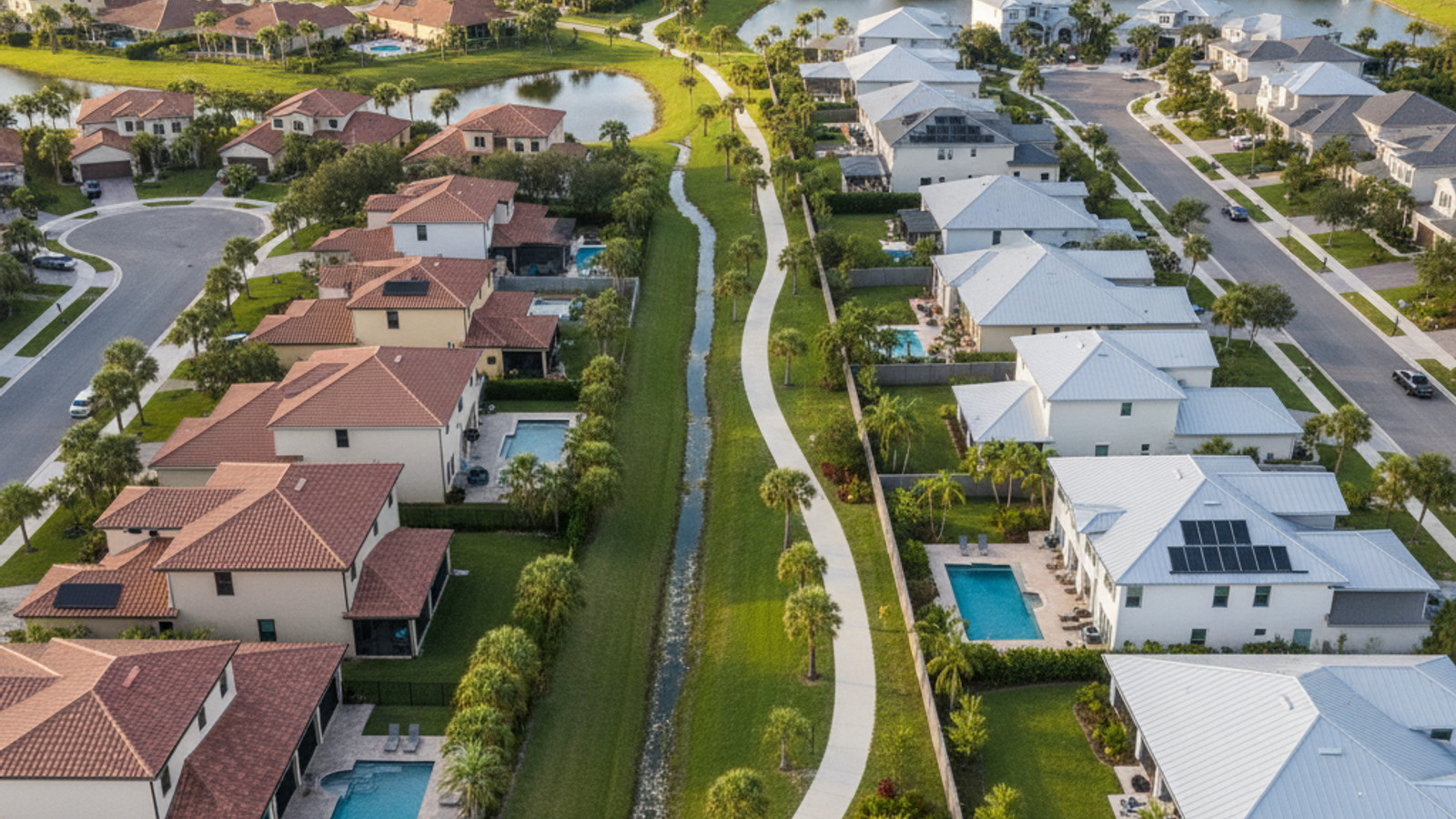
Buyers looking at Riverland, Port St. Lucie, FL often ask about the daily forecast. For a home purchase, though, the long-term climate matters far more than this week's weather. It dictates your monthly cooling costs, your homeowners insurance premiums, and the best time of year to negotiate on a house. For a broader look at the community, read about the pros and cons of living in Riverland.
Understanding how the seasons shift on the Treasure Coast helps you set a realistic budget and a smart touring schedule. The weather here shapes the condition of the homes you tour and the position you hold at the closing table.
Key takeaway
Riverland has mild, dry winters and long, hot, rainy summers inside a June-to-November hurricane season, making summer the most revealing time to shop for a home. Touring between June and September shows how a house handles daily downpours and heavy air conditioning use, and lets you negotiate in a slower market where homes recently sat a median 88 days. If you can only visit in winter, you get to experience the comfortable dry-season lifestyle, but you should request the wind mitigation report and a year of power bills before committing.
Who this guide is for
You're considering a move to Riverland or a home purchase there, and you're deciding what the climate means for which house you choose and when you shop for it.
Understanding the climate in Riverland, FL
The long, hot, wet storm season from June to November is both the real cost of owning here and the best window to test and negotiate for a house. In the 90 days ending September 30, 2026, single-family homes sold at a median 88 days on market with 5.4 months of supply, while prices fell 7.7% year over year.
Riverland sits inland in western Port St. Lucie, slightly removed from immediate coastal breezes. The official climate normals and National Weather Service (NWS) point forecasts come from stations closer to the coast, so treat these averages as close approximations and expect inland afternoons to differ slightly.
Questions to ask before you pick a move date or a home
If you can visit between June and September, you can see drainage and AC systems under real load. If you can't, you'll lean on documents rather than observation to understand the property's condition.
If the home will sit closed for the summer, figure out who handles storm preparation in your absence. If insurance premiums are a major budget factor, get a quote during the inspection period. If water is your biggest worry, check the official flood zones before shortlisting a property.
Riverland weather by season
The Treasure Coast splits the year into a comfortable dry half and a hot, wet half. Each season gives you a different view of a property and a different level of buyer competition. Touring across different months changes what you can physically verify about a home's performance, and the seasonal shift has a direct effect on outdoor routines and utility bills.
Summer and the wet season (June to September)
Hot, humid mornings give way to frequent afternoon thunderstorms through summer. The NWS reports the wet season for the nearby Fort Pierce station typically runs from May 25 to October 20. August brings an average high of 89.2°F, according to 1991–2020 NOAA normals for the Fort Pierce station.
This stretch also covers the latest housing market data, making it a prime window to test a property under real conditions. The downside is straightforward: the air conditioning runs hardest, and storms are most likely.
Winter in Riverland (December to February)
Winter brings the dry, low-humidity season. It feels warm compared to most of the mainland United States. The January average high is 72.4°F with a low of 53.0°F, based on 1991–2020 NOAA normals for Fort Pierce. Occasional cold fronts pass through and drop temperatures for a few days before conditions warm again.
The catch is that winter shows a house at its best. Dry, mild days hide how the home and lot handle summer downpours and AC load, so a winter-only tour misses the season that costs the most.
Spring in Riverland (March to May)
Spring is a warming, mostly dry stretch. It feels comfortable early in the season before building heat arrives by May, ahead of the summer rains. The May average high reaches 84.4°F, per 1991–2020 NOAA normals for Fort Pierce.
What you give up is the cooling effect of afternoon showers. Late spring heat arrives before the wet season's storms do, so May can feel like summer without the relief.
Fall in Riverland (October and November)
Fall is a transition season on the Treasure Coast. Humidity and rain taper through October into a drier November. Hurricane season officially runs through November 30, though, so fall isn't storm-free. Late-season storms remain a possibility.
Rain, humidity, and heat in Riverland
Daily comfort in Port St. Lucie comes down to managing moisture in the air and water on the ground. The local weather patterns demand specific home maintenance routines, and both elements drive a large portion of your annual ownership costs.
How much rain falls in Riverland?
The Fort Pierce station records an annual average of 55.89 inches of rain, based on 1991–2020 NOAA normals. The NWS notes that nearly two-thirds of the region's annual rainfall drops during the wet season. Heavy short bursts are the norm, which puts lot grading, gutters, and community retention ponds to the test.
You only learn how a specific lot drains by seeing it after a heavy afternoon storm. A dry-season showing can't tell you where water stands.
How humid is Riverland?
Summer mornings start with high humidity that builds until the afternoon showers break the heat. A home left closed in summer needs the air conditioning or dehumidification set to protect against moisture, which means running the AC even when nobody is there. You won't get a break on your seasonal power bill.
Afternoon thunderstorms and lightning
The summer daily weather cycle brings frequent afternoon thunderstorms. Outdoor activities like golfing or walking naturally shift to the mornings. Frequent lightning strikes make surge protection and a check of the home's grounding worth asking about. Ask an electrician or inspector to review the panel, since replacing fried appliances is an out-of-pocket cost.
Hurricanes, flooding, and severe weather in Riverland
Official data gives you the clearest picture of severe weather risks on the Treasure Coast. County and federal mapping tools help you evaluate a specific property, and every home in the area carries some level of storm exposure regardless of its distance from the beach.
Hurricane season in Riverland
The Atlantic hurricane season runs from June 1 to November 30. National Hurricane Center (NHC) records show that two hurricanes, Frances and Jeanne, made landfall on this stretch of coast within weeks of each other in 2004. Look up your evacuation zone with St. Lucie County Emergency Management rather than assuming an inland location is exempt.
An inland address reduces surge exposure, but it doesn't remove wind risk or the prospect of extended power outages. You still need a comprehensive storm plan.
Flood zones and drainage
Check the property's status on FEMA's Flood Map Service Center to understand its official risk level. Standard homeowners insurance doesn't cover flood damage; that requires a separate flood policy, according to FEMA. For more on local safety data, review our guide to flood zones and safety in Riverland.
A zone designation doesn't show how one street or lot handles a summer downpour. Check the property itself and the seller's disclosures for any past water intrusion.
Tornadoes
St. Lucie County has a documented history of tornado activity, according to NWS Melbourne. Recent NWS storm surveys confirmed an EF-0 tornado touched down in Port St. Lucie on August 23, 2026. Tornadoes tied to tropical systems can form quickly with short warning times, so a weather radio or phone alerts matter even far from the coast.
Freezes and cold fronts
Winter cold fronts occasionally push through the area, though hard freezes are rare. NWS Melbourne records show Fort Pierce dropped to a record low of 23°F on February 2, 2026. Tropical landscaping is planted for heat, so a rare freeze night can damage it. Covering plants becomes the owner's responsibility when a hard front comes through, which means keeping an eye on the winter forecast.
What the climate means for the home you buy
The local weather directly dictates how homes are built and insured in St. Lucie County. Verifying construction standards and efficiency ratings protects your budget from sudden repair bills, and every unverifiable detail about a home's storm readiness is a reason to request official documentation.
Wind-rated construction and the Florida Building Code
St. Lucie County homes are built to the Florida Building Code's wind design requirements. The county falls within the Wind-Borne Debris Region, which mandates impact-resistant glazing or approved shutters on openings. Riverland's housing stock consists of newer single-family construction, so the exact code edition depends on the permit date.
Read our new construction guide for Riverland to see which communities are still building. Being built to code isn't the same as having impact glass on every opening, so check whether windows and doors carry wind-rating labels.
Wind mitigation and insurance
Florida law requires insurers to offer premium discounts for documented wind-resistive features, such as roof attachment and opening protection. These details are recorded on the state's uniform wind mitigation form, and the same house can quote differently depending on what the inspection documents.
See our Riverland cost of living guide for more on monthly ownership expenses. Discounts only apply to what an inspector can verify, so request the home's existing wind mitigation report early in the inspection period.
Hurricane shutters and HOA rules
Florida law requires homeowners associations to adopt hurricane shutter specifications and generally prevents them from denying an owner's shutters that meet those standards. Riverland homes sit in HOA-governed communities, so the specific rules come from the association. Check our Riverland HOA fees guide to see what each community covers.
The association may set rules on when shutters go up and come down. If the home will sit empty part of the year, ask the HOA for its storm-preparation rules to understand who handles the work.
Air conditioning and summer power bills
The climate's ongoing cost is cooling the house. To see the true expense for a specific property, ask the seller for 12 months of electric bills and compare summer months to winter months. Ask for the AC system's age and service records to gauge its condition. An older system working through a Riverland summer can turn into an unplanned replacement.
Best time to visit or buy in Riverland
Your touring schedule forces a choice between personal comfort and negotiating strength. The time of year you shop dictates what you can see with your own eyes, and visiting during the pleasant months hides the home's stress points while summer shopping reveals them.
Touring in the dry season
January to April is the comfortable time to see the community, amenities, and outdoor life. Review our guide to the best neighborhoods in Riverland to narrow your search. Pair a winter visit with document requests: ask for the wind mitigation report, power bills, and permit date.
You won't see drainage, humidity, or AC under summer load. For the things that cost the most, you'll be relying on paperwork.
Buying in the wet season
The latest market window covers July to September, directly reflecting summer buying conditions. Single-family homes sold at 97.3% of their list price with 5.4 months of supply. At that ratio on a hypothetical $500,000 list price, a sale closes at about $486,500, giving buyers room to negotiate on price, repairs, or closing terms.
Check our Riverland housing market page for full market trends. You may be under contract with a storm on the map, which can delay insurance binding or closing. Ask the insurer whether it stops binding new policies when a named storm approaches.
At a glance
- Median sale price, single-family homes: $517,064 (90 days ending Sept. 30, 2026)
- Year-over-year change in median sale price, single-family homes: -7.7% (90 days ending Sept. 30, 2026)
- Single-family homes sold: 41 (90 days ending Sept. 30, 2026; this window covers July to September, the wet and peak-hurricane months)
- Median days on market, single-family homes: 88 (90 days ending Sept. 30, 2026)
- Sale-to-list price ratio, single-family homes: 97.3% (90 days ending Sept. 30, 2026)
- Share of single-family homes sold above list price: 5% (90 days ending Sept. 30, 2026)
- Months of supply, single-family homes: 5.4 (90 days ending Sept. 30, 2026)
- Single-family homes in inventory: 72 (90 days ending Sept. 30, 2026)
- Median price per square foot, single-family homes: $288 (90 days ending Sept. 30, 2026)
Frequently asked questions
What part of Florida has the best weather year round?
It depends on whether warm winters or milder summers matter more to your daily routine. The Treasure Coast sits between north Florida, which sees cooler winters, and far south Florida, which offers warmer winters but similarly hot, wet summers. A review of NOAA normals shows Fort Pierce averages a January high of 72.4°F, placing it right in the middle for winter comfort.
Does it snow in Riverland, FL?
No, it doesn't snow in Riverland for any practical purpose. The only documented snowfall in South Florida's recorded history occurred during a historic cold wave in January 1977. During that event, flurries reached as far south as Miami-Dade County.