


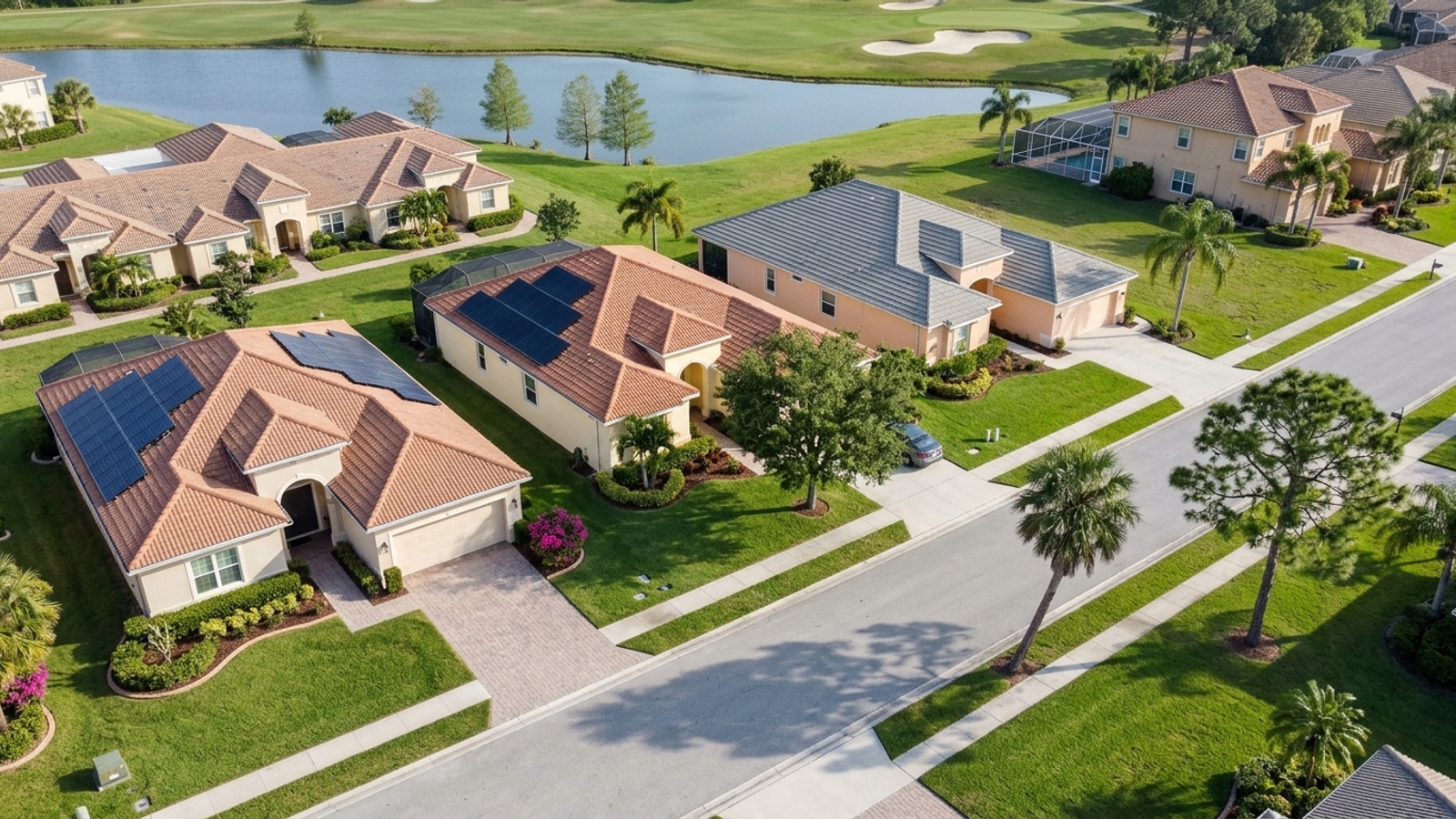
Buying a home in St. Lucie County means budgeting for more than just the mortgage and HOA fees. You have to account for the monthly cost to keep the lights on, the water running, and the house cool through the humid summer.
Utility costs in PGA Village, FL, come down to who bills you and what services are already covered by your property taxes or community dues.
Key Takeaway
Your power and water providers in PGA Village are set by your address, so the bill that varies most between homes is the FPL electric bill, driven by square footage and AC age. Ask the seller for 12 months of actual bills before you offer; single-family homes are taking a median 108 days to sell, so you usually have time. If keeping bills down matters most, a townhouse gives you less space to cool and shared walls.
Who This Guide Is For
You're weighing a specific PGA Village home and want to know who will bill you for power, water, trash, and internet, and what those bills will add to your monthly budget, before you make an offer.
How Utilities Work in PGA Village
Three things make one home's utilities cost more than another's:
- the house itself: its size, its AC and its pool equipment
- what the HOA dues already include
- what the tax bill carries
Current market conditions give buyers time to check all three before committing. Familiarity with the pros and cons of living in PGA Village, FL helps you prepare for these ongoing costs.
Before you start comparing homes, get clear on four things:
- Is the home single-family or a townhouse? Size and shared walls change the electric bill more than anything else.
- Does the HOA already pay for cable, internet, or irrigation water? If so, you're budgeting fewer separate bills.
- Does the property tax bill carry trash, stormwater, or CDD charges? These are utility-type costs that never arrive as a monthly statement.
- Is the home all-electric, or does it use natural gas or a propane tank? That determines if you'll be managing a third energy account.
Who Provides Utilities in PGA Village?
Electricity
Florida Power & Light (FPL) serves Port St. Lucie as a regulated utility. The main variable on your bill is usage, and summer air conditioning dominates it.
Effective January 1, 2026, FPL's Residential Service rate charges:
- a $10.52 monthly base charge
- 7.865 cents per kilowatt-hour (kWh) for the first 1,000 kWh
- 8.865 cents per kWh for additional usage
Riders for conservation, storm protection, fuel and other charges bring the blended rate for the first 1,000 kWh to about 12.258 cents per kWh. That produces a typical bill of roughly $133 to $137 a month at that usage level.
The catch is the higher rate past 1,000 kWh. A large, poorly insulated home easily crosses that line in summer and pays the higher rate on every extra unit of power.
Water and Sewer
The City of Port St. Lucie Utility Systems Department is the primary provider of water and sewer services to Port St. Lucie and a portion of unincorporated St. Lucie County. Its service area covers more than 130 square miles and over 90,000 customers. Confirm the provider for the specific address rather than assuming one for every street.
Your monthly bill is a base facility charge plus tiered usage charges per 1,000 gallons. On a standard meter, the residential single-family base facility charge is $11.16 a month for water and $17.65 a month for wastewater, before any usage is billed.
A new-account deposit is required. Opening this account is a separate step from closing, so don't assume the seller's water service carries over to your name. Confirm the deposit amount with the utility department ahead of time.
Irrigation and Reclaimed Water
Lawn watering is often handled by the HOA or master association, or supplied as reclaimed water, so it doesn't run through your household meter. The city does operate a reclaimed water utility, but don't assume it serves every PGA Village lot.
For unincorporated St. Lucie County, the County has adopted a year-round watering schedule that limits irrigation to two days a week. Your days depend on whether your address is odd or even.
If a home's irrigation runs on household water instead of a shared or reclaimed system, the monthly water bill can run far higher. Ask the HOA which system applies to the specific lot you're viewing.
Trash and Recycling
The city arranges trash collection, disposal, and recycling under its franchise agreement with FCC Environmental Services. For the fiscal year starting October 1, 2025, the annual solid waste non-ad valorem assessment is $467.33 per dwelling unit, about $38.94 a month. That is up $20.89 from the prior year.
The charge shows up once a year on the property tax bill. Buyers who budget only for monthly bills miss it until the tax bill arrives.
Natural Gas and Propane
Many homes in this community are entirely electric. Some use natural gas where a line exists, or a propane tank for the range, water heater, or pool heater.
Florida City Gas provides natural gas service in St. Lucie and surrounding counties. Not all homes are connected, so availability at a specific address depends on local distribution lines.
A propane tank may be leased from a supplier rather than owned outright. Confirm who owns the tank and whether the lease transfers to the new owner.
Internet, Cable and Phone
Internet and cable providers vary by street, so check service options for your specific address. Some neighborhoods have master associations that buy cable or internet in bulk and bill it through dues.
If the HOA has a bulk contract, you pay for it through your dues whether or not you use the service. Upgrading to a faster plan with a different provider means paying twice. Ask the HOA for the contract's speed tier and end date.
Single-Family Home or Townhouse: How Size Changes the Bills
The more space a house has to cool and the more exterior walls it exposes, the more power it draws during the long Florida summer.
Single-Family Homes
The median single-family sale price of $459,884, divided by the median $223 per square foot, implies a typical home of about 2,060 square feet. That's a rough estimate rather than a measured median, but it illustrates the cooling demand. More roof space, more exterior walls, and often a private pool mean more air conditioning and pump runtime.
If you want room to negotiate an aging AC or pool pump into the price, start with single-family listings. Pool pumps and heaters add a second large electric load that no square-foot estimate captures. Ask the seller whether the pump is variable-speed and when it was last replaced.
Townhouses
The same math works for townhouses. The median townhouse sale price of $346,500, divided by $206 per square foot, implies about 1,680 square feet. That is roughly 380 square feet, or 18%, less space than a typical single-family home.
With similar AC equipment and thermostat settings, a townhouse cools noticeably less space, and shared walls reduce the heat gained from the sun. Compare actual bills to see the exact savings for a specific unit.
The trade-off is a tighter market. Townhouses have just 2.3 months of supply, and prices are up 4.4% year over year based on 35 recent sales. You'll have less room to ask the seller to address an aging AC before closing.
Utility Costs Inside HOA Dues and the Tax Bill
Several utility-type services are bundled into other mandatory payments tied to the property rather than billed monthly.
What HOA Dues May Cover
Community dues can include irrigation water, common-area electricity, bulk cable or internet, and sometimes exterior water for townhouses. If you want fewer separate monthly bills, look for homes whose HOA included-services list covers irrigation and cable or internet.
HOA fees and what they include vary by sub-association. The master association and the neighborhood association may each bill separately.
Assessments on the Property Tax Bill
The city's stormwater fee and solid waste charge appear as non-ad valorem lines on your tax bill. For the current fiscal year, the stormwater assessment is $189 per developed single-family residential unit, a $6 increase from the prior year.
These are flat fees based on the service, not taxes based on the home's assessed value. They don't go away when the homestead exemption applies.
CDD Assessments in Newer Sections
The Verano section is subject to community development district (CDD) non-ad valorem assessments. Several districts levy them on benefitted property to fund infrastructure such as roads, water management, and utilities, and they are collected on the St. Lucie County property tax bill. For reference, Verano #2 CDD reported $2,057,587 in total assessments for fiscal year 2023.
Older original PGA Village subdivisions generally don't carry a CDD assessment.
In a CDD, part of what you pay for water and sewer pipes shows up on your tax bill, not your utility bill. CDD debt assessments can run for decades. Confirm the remaining term and annual amount on the parcel's current tax bill before you close.
How to Check a Home's Utility Costs Before You Buy
Statewide averages won't tell you what a specific property costs to run, so verify the actual expenses during the due diligence period.
Ask the Seller for 12 Months of Bills
A full year of FPL and city water statements gives you real numbers in place of estimates. It captures both the high summer cooling loads and the milder winter months.
FPL offers a free online tool called FPL Energy Manager that tracks a home's energy usage over time and compares it to similar homes in the area. Ask the seller for that usage history.
Single-family homes are sitting at 5.3 months of supply and selling at 97.5% of list price, so sellers are rarely in a position to refuse this request.
One caveat: a seasonal owner's bills will understate year-round use. Ask how many months of the year the home was occupied.
Get the HOA's List of Included Services
Ask the association for a written list for the specific address covering irrigation, cable or internet, exterior water, and trash. Compare it against your monthly budget so you don't accidentally pay twice for a service.
Read the Tax Bill Line by Line
Pull the current bill from the St. Lucie County Tax Collector and list every non-ad valorem charge, including trash, stormwater, and any CDD fees. Divide the total by twelve and add that figure to your monthly budget.
The flat assessments carry over to you exactly as printed. The tax on the property value may not, because the seller's bill reflects their specific exemptions.
Check the AC, Water Heater, and Pool Equipment
Equipment age drives the electric bill as much as the home's size. Have your inspector note:
- the AC age and efficiency rating
- the water heater type
- the pool pump type
A system near the end of its life becomes a negotiation point. An inspector only reports what's visible and working on inspection day, and remaining life is an estimate. Get a replacement quote if the unit is old.
Setting Up Utilities and Preparing for Storm Season
Once you have a closing date, schedule your service transfers early to prevent disruptions on move-in day.
Transferring Service at Closing
Contact FPL, the city utility department, and your internet provider to set up accounts in your name.
If the seller stops service before you start yours, your final walkthrough can happen with no power or water. Ask the seller to keep service on through the closing date.
Power Outages and Generators
Hurricane-season power outages are a standard part of owning a home on the Treasure Coast. A standby or portable generator adds to your upfront costs. Standby generators typically need HOA architectural approval and a proper permit, so ask the HOA for its generator rules before you buy one.
At a Glance
- Median sale price, all homes: $439,866 (90 days ending 2026-09-30, 338 sales)
- Median sale price, single-family: $459,884, down 2.9% year over year (90 days ending 2026-09-30, 299 sales)
- Median sale price, townhouses: $346,500, up 4.4% year over year (90 days ending 2026-09-30, 35 sales)
- Median price per square foot: $223 single-family, $206 townhouse (90 days ending 2026-09-30)
- Median days on market: 108 single-family, 143 townhouse (90 days ending 2026-09-30)
- Sale-to-list price: 97.5% single-family, 98.3% townhouse (90 days ending 2026-09-30)
- Months of supply: 5.3 single-family, 2.3 townhouse (90 days ending 2026-09-30)
- Active inventory, all homes: 547 (90 days ending 2026-09-30)
PGA Village Utilities FAQs
Why Is Florida's Electric Bill so High?
Florida residents run air conditioning nearly year-round to manage heat and humidity. FPL bills also add fuel, conservation, environmental, and storm protection riders on top of base energy charges, which lift the blended rate described above.
How Much Is a Typical Water Bill for 2 People in Port St. Lucie?
You pay the city's water and wastewater base facility charges plus tiered charges per 1,000 gallons. If two people use 4,000 gallons a month, they pay the base charges plus the tiered rate for those 4,000 gallons of water and sewer.
Is $100 a Month a High Water Bill in PGA Village?
It depends on your usage and whether you pay for sewer. Beyond the base charges, a $100 bill implies heavy tiered gallonage. That usually comes from irrigation running on the household meter rather than a separate or reclaimed system.
What Uses the Most Water in a Florida Home?
Outdoor irrigation is typically the largest draw. The South Florida Water Management District states that approximately 50 percent of residential water used by South Florida residents goes to lawn and garden irrigation, which is why the county's two-day watering schedule exists.
Is There Help Paying Utility Bills in St. Lucie County?
St. Lucie County residents can apply for the Low Income Home Energy Assistance Program (LIHEAP) through ALPI, which requires total household gross income of no more than 150% of the Federal Poverty Guidelines. FPL also offers Care to Share, an income-qualified program for emergency bill help and up to $2,000 for electrical repairs, administered by local agency partners. You can also ask the utilities directly about payment arrangements.
Do PGA Village Homes Have Well Water or City Water?
Homes here are generally on municipal water from the City's Utility Systems Department. Confirm the water source and any well rules for a specific address with the seller and the utility department.
Sources
- Redfin: Data Center
- FPL: Residential Rates
- City of Port St. Lucie: Utility Divisions
- City of Port St. Lucie: Code of Ordinances
- St. Lucie County: Landscaping & Irrigation Restrictions
- City of Port St. Lucie: Solid Waste Assessment
- Florida City Gas: About Us
- City of Port St. Lucie: Stormwater
- FPL: Energy Manager
- City of Port St. Lucie: Utility Systems
- U.S. Energy Information Administration: Average Monthly Bill
- South Florida Water Management District: Fact Sheet
- ALPI: Apply Online