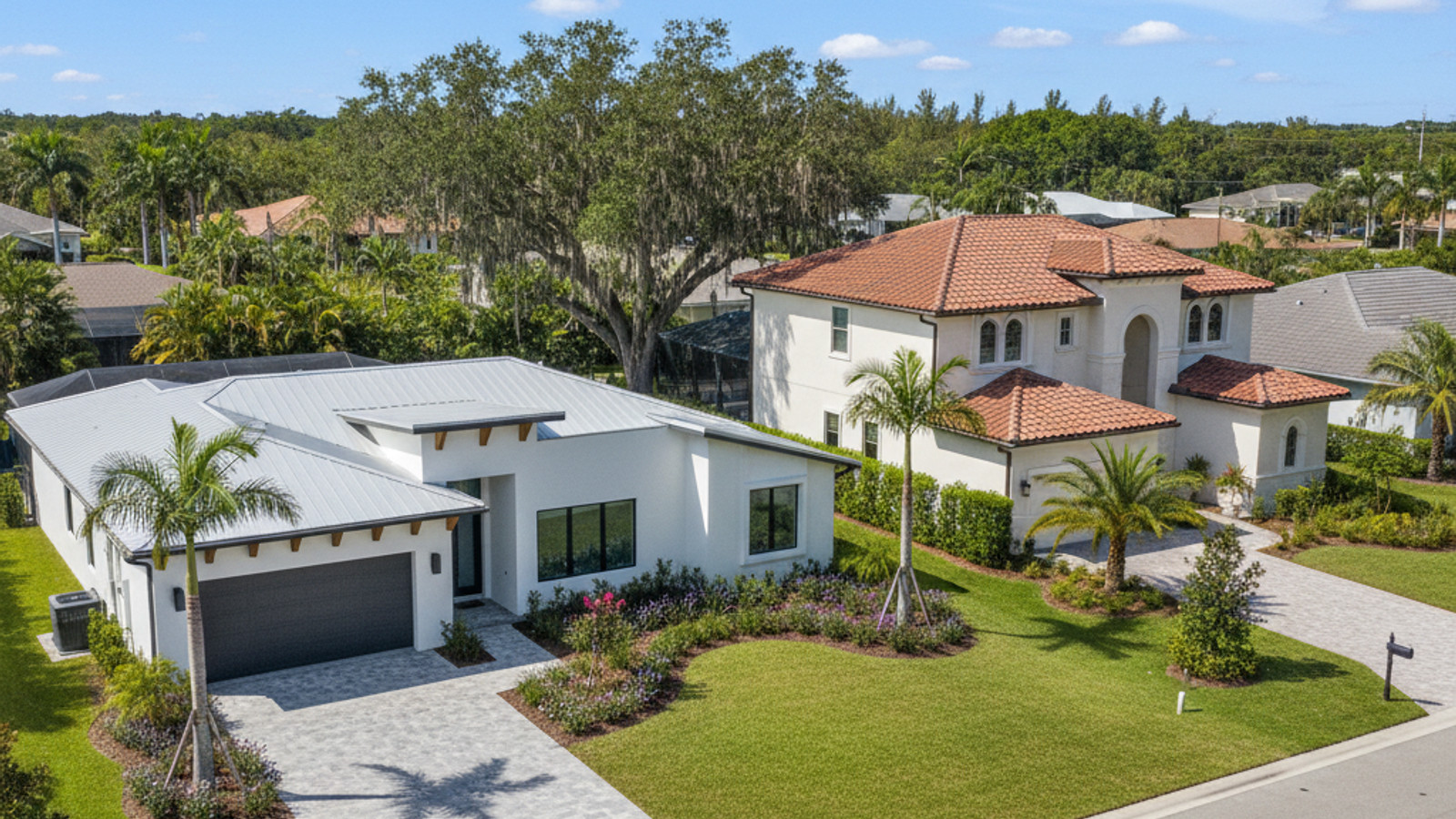
Port St. Lucie continues to attract buyers looking for exceptional weather and modern amenities on Florida's Treasure Coast. Navigating the local housing market often comes down to choosing between a traditional municipal neighborhood and a structured master-planned development.
For 55+ active adult buyers, this decision frequently centers on evaluating Riverland vs Port St. Lucie FL at large. Understanding the differences in daily carrying costs, home construction, and lifestyle access is essential for making a confident purchase in 2026.
Housing Market Overview: Riverland vs. Port St. Lucie
The broader Port St. Lucie real estate market offers a wide variety of housing options, from established non-HOA neighborhoods to newer subdivisions. In early 2026, the median home price across the city sits between approximately $375,000 and $400,000. Buyers looking outside of master-planned communities generally find a highly competitive market driven by lower monthly carrying costs.
By contrast, Riverland operates as a specialized 55+ development built exclusively by GL Homes. Pricing here begins in the $340,000s for smaller villas and scales well over $1,000,000 for premium single-family properties. The clear takeaway is that while Riverland's entry-level pricing mirrors the city median, buyers pay a premium for the curated lifestyle and newer construction.
Property Types, Lot Sizes, and GL Homes Floor Plans
Standard Port St. Lucie neighborhoods typically feature quarter-acre lots with varying architectural styles and no uniform community design. Homes in these municipal areas often require buyers to manage their own exterior maintenance and landscaping upgrades.
Properties within Riverland are built with strict design cohesiveness and range from roughly 1,300 to over 3,500 square feet. Current collections in neighborhoods like Valencia Walk and Valencia Parc feature modern construction standards, including concrete tile roofs and impact-resistant windows.
Cost of Ownership: Analyzing HOA and CDD Fees
Calculating the true cost of living in Florida requires looking closely at recurring monthly and annual assessments. Many master-planned developments in St. Lucie County utilize Community Development District fees to fund local infrastructure. These CDD fees can easily add an estimated $1,500 to $3,000 or more to a homeowner's annual tax bill.
A major financial advantage for Riverland residents is that the community carries absolutely zero CDD fees. Homeowners instead pay a standard monthly Homeowners Association fee ranging from approximately $400 to $500. This assessment covers comprehensive lawn care, gate security, and maintenance of the extensive communal facilities.
Purchasing a home in a standard Port St. Lucie neighborhood eliminates these mandatory association fees entirely. However, buyers must remember that they will bear the full out-of-pocket costs for their own landscaping, private pool maintenance, and security systems.
Amenities: Resort-Style Living vs. Municipal Recreation
The City of Port St. Lucie maintains an impressive array of public parks, boat ramps, and nature preserves available to all residents. Golfers can easily book tee times at several public courses, and municipal recreation centers offer various fitness programs. Relying on city amenities is an excellent choice for buyers who prefer a decentralized, independent lifestyle.
Riverland takes a completely different approach with its massive 4,000-acre master plan designed entirely around pedestrian and golf cart connectivity. Paying an HOA fee here secures immediate, private access to resort-style facilities that rival high-end vacation destinations. For buyers prioritizing convenience, having world-class recreation located just a short cart ride from the driveway easily justifies the monthly cost.
Riverland's Wellness Center, Paseo Park, and Arts Facilities
The exclusive amenities located within the Riverland gates are scaled to accommodate a large, active 55+ population. Residents do not need to leave the community to access professional-grade fitness equipment, organized sports, or cultural events.
The development features several distinct hubs connected by dedicated pathways. Key facilities available to residents include:
-
A 51,000-square-foot Wellness and Fitness Center dedicated to physical health.
-
A massive 34,000-square-foot clubhouse hosting social events and gatherings.
-
A 14-to-16-acre Sports and Racquet Club equipped with 37 pickleball courts and multiple tennis courts.
-
A 5-acre Arts and Culture Center offering specialized programming and classes.
-
The 12-acre Paseo Park, which anchors the community's extensive network of golf cart trails.
Location Proximity: Commutes, Highways, and Healthcare
Geographic positioning plays a major role in how residents experience daily life on the Treasure Coast. Standard Port St. Lucie neighborhoods are spread across a massive footprint, meaning commute times to highways or grocery stores vary wildly depending on the zip code. Buyers looking at older sections of the city may face longer drives to reach modern retail centers.
Riverland is strategically positioned within the western Tradition area of Port St. Lucie, offering highly streamlined transit access. The community sits just six minutes from Interstate 95 and approximately 20 minutes from the Florida Turnpike. This specific location removes much of the local traffic congestion associated with the central and eastern parts of the city.
Access to premium healthcare is another critical factor for buyers relocating to the region. Riverland offers immediate proximity to the top-rated Cleveland Clinic Tradition Hospital, providing residents with exceptional medical care just outside the community gates. This localized convenience is a massive selling point compared to more isolated rural properties.
Frequently Asked Questions
Is Riverland considered part of Port St. Lucie?
Yes, Riverland is located within the municipal boundaries of Port St. Lucie, Florida. It is situated in the western section of the city near the Tradition master-planned area.
Do all master-planned communities in Port St. Lucie have CDD fees?
No, not all developments require these infrastructure assessments. While neighboring communities like Tradition and PGA Verano carry substantial annual CDD fees, Riverland properties are sold with zero CDD fees attached.
What is the median cost of a home in Port St. Lucie in 2026?
In early 2026, the median home price across the broader Port St. Lucie market ranges from approximately $375,000 to $400,000. This figure includes a wide mix of older non-HOA homes and newer construction properties.
How do HOA fees in Riverland compare to standard Port St. Lucie neighborhoods?
Standard municipal neighborhoods in Port St. Lucie typically have no HOA fees at all. Riverland charges an estimated $400 to $500 monthly, which covers private amenities, gate security, and comprehensive lawn care.