


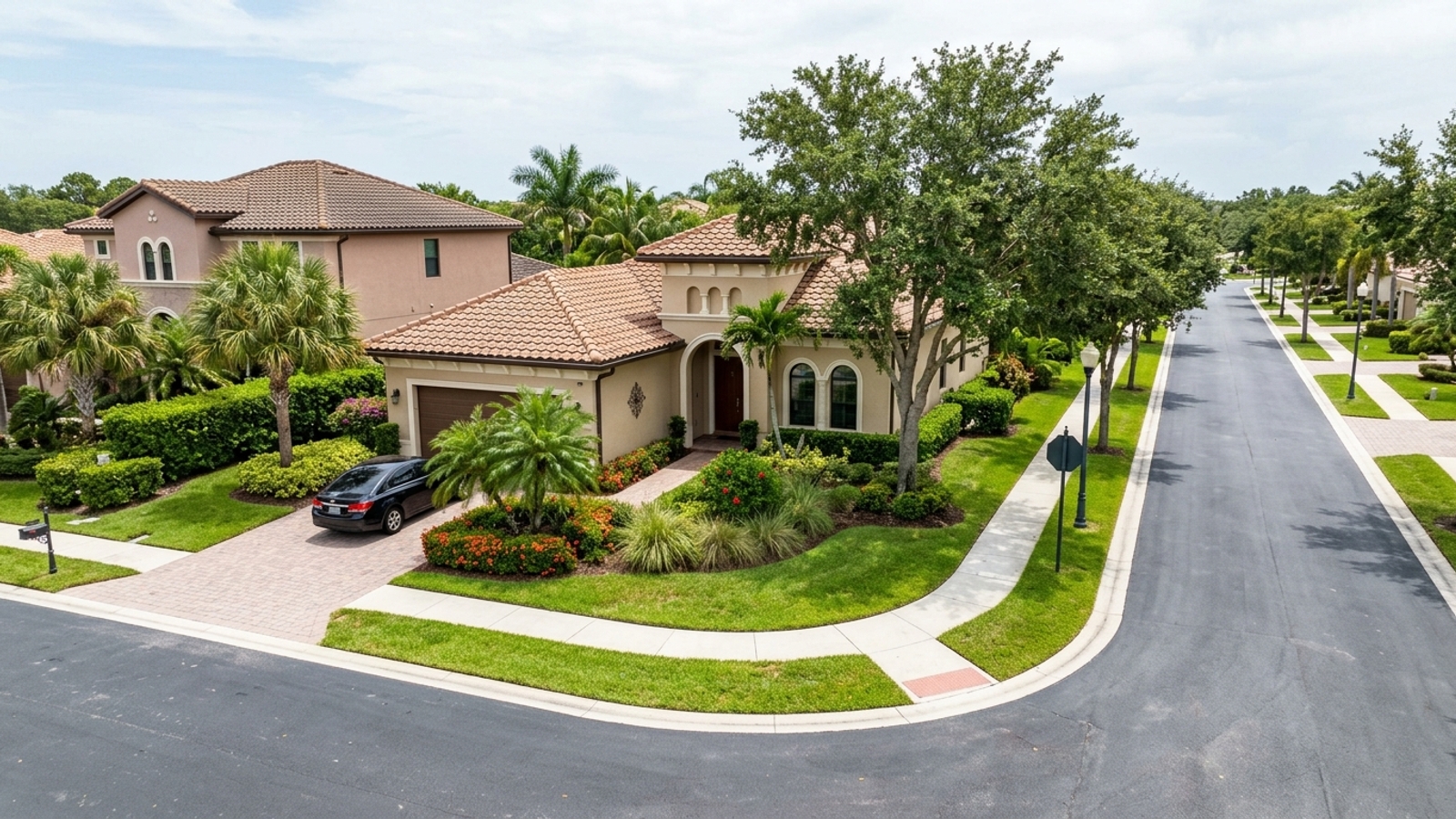
Port St. Lucie buyers doing serious homework on living in PGA Village Verano tend to land on the same shortlist: Verano or Tradition. As of mid-2026, Verano's median sale price sits at roughly $497,000, with 183 homes on the market averaging 124 days before going under contract. That 8.7-month supply is real breathing room - you can take your time comparing new builds against established resales without feeling like you'll miss the window.
Getting to the right answer means looking past the brochures. Both communities offer extensive amenities, but they're built around different rhythms of daily life. The pricing, HOA structures, and inventory each tell their own story, and understanding those differences is what will actually point you toward the right fit.
Understanding the Housing Markets in Verano and Tradition
Verano's market runs through a single primary builder - Kolter Homes - which shapes everything from the floor plan options to the resale pool. You'll find active new construction phases alongside established resale streets, and homes here are closing at about 97.8% of list price. Sellers aren't leaving much on the table, but they're not overreaching either.
Tradition operates at a different scale entirely. It's been built out by multiple developers over two decades, which means a much wider range of housing types - townhomes, large single-family estates, older phases near the town center, and brand-new sections pushing out toward the western edges. The inventory reflects that diversity.
The underlying character of each community is worth sitting with for a moment. Verano is a self-contained, resort-style environment organized around golf and club life. Tradition is closer to an actual town - commercial zones woven into the residential fabric, not kept at arm's length outside the gates. That distinction matters more than any spec sheet, and it's the first question worth answering honestly about yourself as a buyer.
Architectural Character and Existing Homes
The broader St. Lucie County area has real architectural history - Mission/Spanish Revival, Classical Revival, and the Mediterranean Revival styles that defined St. Lucie Estates in the 1920s and 1930s. Verano and Tradition are modern developments, but their resale inventory frequently echoes those influences: barrel-tile roofs, stucco exteriors, the whole Mediterranean vocabulary rendered in contemporary materials.
Buying a resale also means walking into a yard that's already grown in. Mature landscaping, completed neighborhood infrastructure, none of the construction staging that follows a new phase for the first year or two.
Mature Lots and Resale Availability
In the older phases of PGA Village Verano - including some Cresswind properties - you're often getting aftermarket upgrades the original buyer paid for: custom pool enclosures, finished patios, tropical landscaping that a new build simply won't have on day one. For buyers who want to move in and be done with it, that has real value.
Tradition's resale market runs deeper, given how long the community has been building out. Homes from the late 2000s phases come with different floor plan configurations and lot sizes than what the newest sections are offering, which can work in your favor depending on what you're after.
Maintenance and Upkeep for Older Phases
A resale home in any master-planned community still ages like any other house. Properties from Tradition's early phases or Verano's initial buildout - now ten to fifteen years old - may be approaching the point where roofs, HVAC systems, or exterior paint need attention.
Get a thorough inspection. Build the potential costs into your offer math. This isn't a reason to avoid resales; it's just part of buying one.
The Draw of New Construction in Port St. Lucie
New construction in Port St. Lucie has a straightforward appeal: you get the floor plan you want, built to current Florida code, with impact-resistant windows and modern hurricane protection baked in from the start. In Verano, Kolter-built homes deliver open-concept layouts, higher ceilings, and finishes that most resales can't match without a significant renovation budget.
Tradition continues expanding too, with newer sections from multiple builders emphasizing smart home technology and energy-efficient design. The ability to choose your own lot, select structural options, and work through an interior design package before breaking ground is a genuine draw for buyers who have specific preferences and the patience to wait.
Builder Warranties and Energy Standards
New construction comes with a warranty structure that matters: typically up to ten years on the structure and one to two years on major systems. For buyers who've owned an older home and dealt with surprise repair bills, that coverage offers real peace of mind.
The efficiency gains are real too. Current HVAC systems, better insulation, and water-saving fixtures in new Verano and Tradition homes will outperform what was standard even a decade ago - and that shows up in your monthly utility bills.
Construction Timelines and Availability
Building from the ground up in Port St. Lucie can take several months to well over a year. That timeline needs to fit your current housing situation and your strategy for locking a mortgage rate.
If you want a new home but can't wait on a full build cycle, both communities typically have quick move-in or spec homes available - properties already under construction or fully finished, with the benefits of new construction on a timeline that's closer to a standard resale.
Cost Comparison: Pricing Out Your Options
New Kolter-built homes in Verano are running $255 to $300 per square foot right now. The 1,259-square-foot Gardenia plan starts around $320,990; larger floor plans in the community range from $371,990 up to $1,149,900 for up to 4,698 square feet.
Resales trade at $240 to $310 per square foot - close enough that price per square foot alone rarely decides the question. A 1,535-square-foot resale recently listed at $384,900; a 3,143-square-foot home was listed at $979,000. When new and existing homes are priced that similarly, buyers end up choosing on lot location and timeline, not on raw purchase price.
When factoring in the cost of living, monthly costs are where the gap opens up. As of 2026, newer-phase and new-construction homes in Verano carry HOA fees generally in the $502 to $620 per month range, with CDD fees applying separately on top of that in those newer sections. Older-phase resales tend to run lower - roughly $444 to $545 per month - depending on the specific phase and home style. That spread adds up over time and deserves a line in your monthly budget before you fall in love with a particular address.
Deciding Which Community Fits Your Goals
This decision really comes down to one honest question: do you want a self-contained resort environment, or do you want something that functions more like a town?
Verano is built around the private, gated club experience - everything recreational within the same footprint, with golf immediately adjacent. If you want all of that contained and consistent, it's a well-executed version of exactly that model. Tradition is built around access - commercial squares, medical facilities, retail, community events, all reachable by golf cart or a short drive, woven into the neighborhood rather than kept outside it.
Tour both. Walk through resale homes and new construction models in each community so you can actually feel the difference in scale and finish. Pull the HOA and CDD fee schedules for specific lots you're considering - the monthly number on any given property can vary enough to change your math.
Frequently Asked Questions
How do the HOA and CDD fees compare between PGA Village Verano and the various neighborhoods in Tradition, FL?
In Verano, newer homes carry HOA fees ranging from $502 to $620 per month plus separate CDD fees; older phases run $444 to $545 per month. Tradition is made up of multiple distinct neighborhoods with their own separate builders and associations, so HOA and CDD fees vary widely depending on which specific subdivision you're looking at. Ask for the exact fee schedule on any property you tour - don't rely on general figures.
Are PGA Village Verano and Tradition strictly 55+ communities, or can buyers of all ages purchase homes there too?
Neither community is strictly 55+. Both are open to buyers of all ages, though Verano includes some specific Cresswind properties and Tradition contains dedicated active adult communities. All-ages options exist in both developments.
Do residents of PGA Village Verano get automatic access to the PGA Golf Club, or is a separate membership required?
No automatic membership comes with a home purchase in Verano. Access to the PGA Golf Club requires a separate membership or daily fee, depending on current club policies. The HOA fees cover Club Talavera and internal Verano amenities - not the adjacent golf courses.
What is the main lifestyle difference between living behind the gates of PGA Village Verano versus the wider Tradition master-planned community?
Verano is a unified, resort-style environment: private, gated, and organized around club amenities and golf. Tradition functions as a larger, interconnected town with public commercial centers, retail squares, and community events integrated among its various residential subdivisions. One is a retreat; the other is a community with its own civic infrastructure.
Which Port St. Lucie community is more golf-cart friendly and walkable to daily shopping and dining, Verano or Tradition?
Tradition is specifically designed around a central commercial hub, so daily shopping, dining, and town square events are genuinely accessible by golf cart or on foot. Verano has extensive internal walking paths and golf cart access to its own club facilities, but getting to grocery stores and retail outside the gates generally means a car.
If pickleball and fitness are my top priorities, how does Verano's Club Talavera compare to the amenity centers found in Tradition?
Club Talavera is a centralized, community-wide complex with a dedicated pickleball center and extensive fitness facilities available to all Verano residents. In Tradition, amenity centers are typically scaled to individual neighborhoods, so what's available to you depends entirely on which specific subdivision you buy into.