


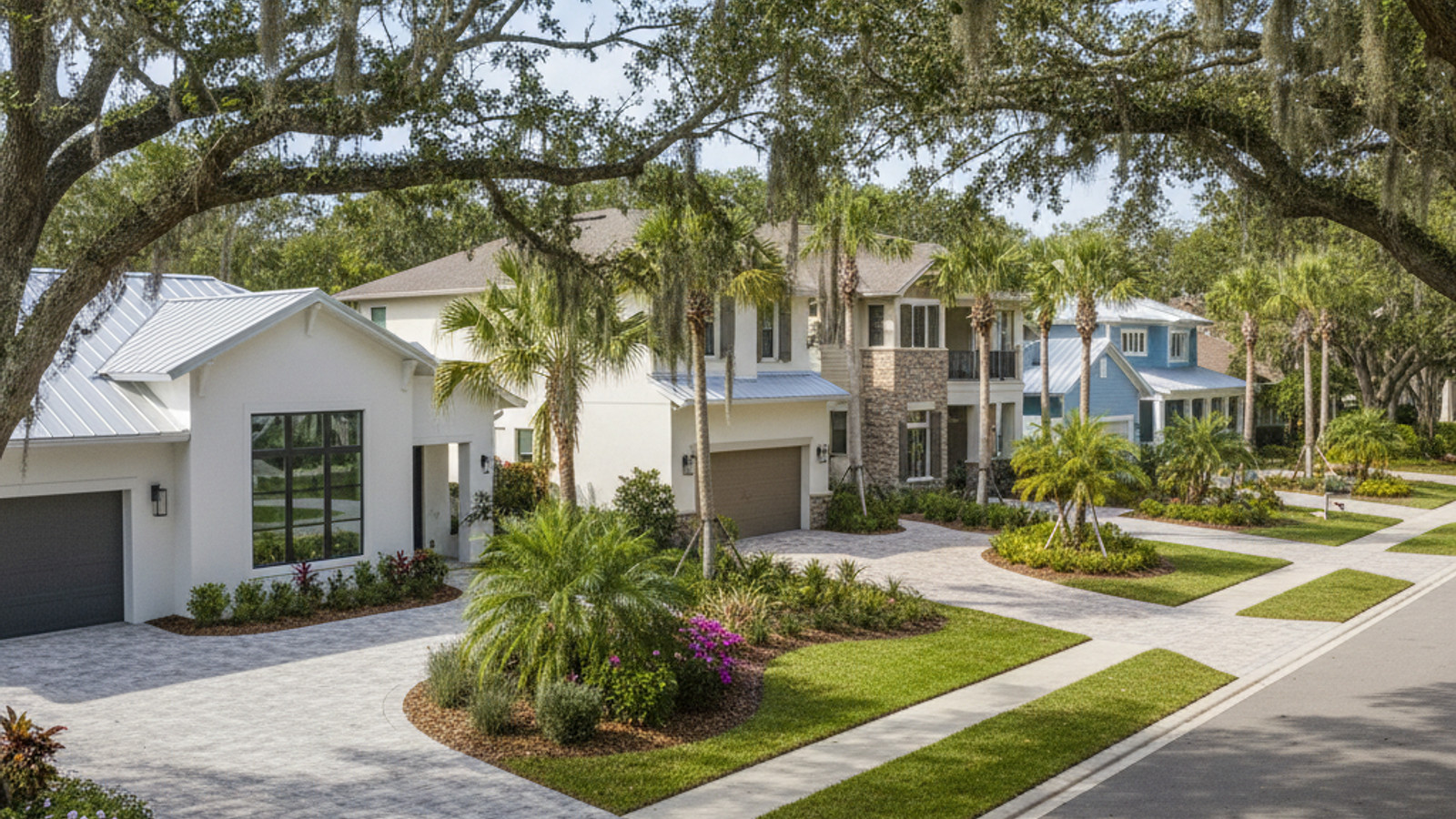
Port St. Lucie has grown fast, and large master-planned communities reshape how residents move through their days. Riverland is built on a dual-network concept: one system for neighborhood recreation, one for getting out into the region. Weighing the pros and cons of living in Riverland helps clarify these daily expectations.
Those two systems overlap in ways that matter. Where your home sits within the gates determines whether you walk to the pool or load up the car every time.
Key takeaway
Plan on a car in Riverland for nearly every trip beyond the community. Inside the gates, the Paseo and amenity network let you walk or bike a lot of daily life. If you want to drive less, pick a home by its distance to the Paseo and clubhouse. If you commute daily, pick by its distance to the exit you'll use most. With single-family homes taking a median 88 days to sell, you have time to test both before you offer.
Who this guide is for
You're considering a home in Riverland and want to know how much of daily life works without a car before you settle on a section or a specific street.
Do you need a car in Riverland?
Riverland runs on two transportation systems: a trail-and-amenity network you can walk or bike inside the community, and a car network for nearly every trip beyond it. The community is accessed via I-95 Exit 114 at SW Becker Road, traveling west and then onto SW Community Boulevard. That means a specific home's position within the community shapes your routine more than which Valencia neighborhood it sits in.
A house close to the Paseo and clubhouse favors a walking routine. One close to the exit you use daily favors a driving routine. Because homes are currently selling at about 97.3% of their list price, buyers have room to be choosy about their specific lot. You can review the best neighborhoods in Riverland and individual Valencia guides to see how different sections lay out.
Getting around inside Riverland
The internal layout prioritizes non-motorized travel between homes and shared amenities, separating pedestrian and bike traffic from main vehicle roads wherever possible.
That design turns fitness and social trips into neighborhood activities rather than driving chores. How often you use these internal routes depends entirely on your exact address and how you prefer to travel.
Walking and biking the Paseo
The Riverland Paseo Greenway offers 4 miles of public, eco-friendly pathways connecting directly to Paseo Park. A home located a short walk from a Paseo access point turns a trip to the amenity hub into something you can do on foot or by bike without a second thought.
The Paseo is built for amenity and recreation trips, though, not grocery runs or medical appointments. Summer heat and rain also limit how often residents walk it midday, so review the weather in Riverland when you're planning an outdoor routine.
Golf carts and low-speed vehicles
Florida law draws a clear line between a standard golf cart and a low-speed vehicle. Under state statutes, low-speed vehicles require registration, insurance, and a driver's license, and they're restricted to streets with a posted speed limit of 35 mph or less. Standard golf carts are prohibited on public roads unless specifically designated by local government.
The City of Port St. Lucie requires City Council approval to designate specific residential communities or roadways for golf cart use rather than offering a blanket citywide designation. You'll need to ask the HOA directly about community-specific rules for private streets, parking, and charging stations. A cart may work fine for clubhouse runs but won't get you through the gates onto public roads without that designation in place.
Getting around outside Riverland
Once you leave the community gates, you're in the standard Port St. Lucie traffic grid, which is designed primarily for cars. Major highways handle regional travel.
Relying on public transit or rideshare changes how you plan your day, since services operate outside the private gates. Knowing what's available helps you manage trips when you'd rather not drive.
Driving: the main roads out of Riverland
Riverland residents rely on SW Becker Road and SW Community Boulevard to connect to the region's major highways. The primary I-95 access point for the community is Exit 114 at SW Becker Road. For trips on Florida's Turnpike, the Becker Road interchange at Exit 138 is operational and is a SunPass-only exit.
Which community exit is closest to your home changes the start of every outside trip. For specific drive times to Palm Beach International Airport or West Palm Beach, you can review commute times from Riverland. West Port St. Lucie is still expanding, so check the city's project page for active road work on the routes you'll drive daily.
Public transit and rideshare
St. Lucie County provides a fare-free public transit system called Area Regional Transit (ART). While ART operates fixed bus routes in more established parts of the city, southwest Port St. Lucie is primarily covered by the ART On-Demand microtransit zone. Zone 1 service operates Monday through Friday from 5:00 a.m. to 9:00 p.m. and Saturdays from 7:00 a.m. to 4:45 p.m., with riders booking trips via a smartphone app.
Rideshare services like Uber and Lyft operate throughout Port St. Lucie. The catch is that buses run on public roads outside the gates, so the walk from your home to a pickup point may be long. Rideshare pickups depend on gate access, and you should ask the community how drivers are let in before counting on them.
Rides for non-drivers and medical trips
St. Lucie County offers transportation-disadvantaged programs and paratransit services for residents who qualify. These county-administered programs provide scheduled rides for medical appointments and essential errands. If you're planning to drive less in the years ahead, you can read about retirement communities in Riverland for more detail on living options.
These programs require booking ahead and have specific eligibility rules, so they don't replace immediate on-demand trips. Confirm your eligibility with the county before building them into your daily routine.
Which part of Riverland fits how you get around?
This comes down to your weekly routine, mapped honestly against the site plan.
If most of your trips are inside the community for fitness or social events, look for homes a short walk from a Paseo access point and the clubhouse, in whichever Valencia fits your budget. With 4 miles of pathways on the Paseo, a house right next to an access point makes a morning walk easy and keeps most amenity trips off the car calendar.
If you commute daily, focus on homes nearest the community exit that leads to the interchange you'll use. Every outside trip starts with the drive out, and that exit choice repeats itself every single day. If you want options for driving less in the future, prioritize homes with the shortest route to the gate nearest a county bus stop or on-demand service area.
Ask yourself whether you expect to drive less over the years you plan to own, and whether you'd use a golf cart for amenity trips. Distance to the Paseo and the main gates varies street by street, so check the specific site plan rather than assuming one Valencia neighborhood is closer than another. You can also compare Riverland vs Tradition for a broader look at how different master-planned communities handle internal travel.
How to test a home's location before you buy
The current market gives you time to verify these routes before you commit. Single-family homes in Riverland are sitting for a median 88 days on market, and active inventory sits at roughly 5.4 months of supply. With median sale prices down about 7.7% year over year to around $517,064, you have room to negotiate if a home's location adds unwanted driving time. There are 72 single-family homes currently for sale, so you don't have to rush into the first house you see.
Drive from the home to your most frequent destination on a weekday at the hour you'd go. Walk from the home to the nearest Paseo access point and time the trip. Open a rideshare app at the property address to see real wait times, and check the walking distance to the nearest county bus stop on the transit map.
Ask the HOA whether golf carts are allowed on community streets and where they can be parked. Confirm eligibility with the county before relying on a transportation-disadvantaged ride program. You can review the Riverland housing market for more pricing details, and if you need help pulling a site plan or setting up timed showings, reach out to schedule a tour.
Riverland single-family market at a glance
- Single-family median sale price: $517,064 (90 days ending 2026-09-30)
- Single-family median sale price change: -7.7% year over year (90 days ending 2026-09-30)
- Single-family homes sold: 41 (90 days ending 2026-09-30)
- Single-family median days on market: 88 (90 days ending 2026-09-30)
- Single-family sale-to-list ratio: 97.3% (90 days ending 2026-09-30)
- Single-family homes sold above list: 5% (90 days ending 2026-09-30)
- Single-family months of supply: 5.4 (90 days ending 2026-09-30)
- Single-family homes for sale: 72 (90 days ending 2026-09-30)
- Single-family median price per square foot: $288 (90 days ending 2026-09-30)
Frequently asked questions
Where is Riverland, FL?
Riverland is a GL Homes master-planned community located within the City of Port St. Lucie. The community is accessed via I-95 Exit 114 at SW Becker Road, traveling west and then onto SW Community Boulevard.
How far is Riverland in Port St. Lucie from the beach?
Reaching the nearest public beach access on Hutchinson Island requires a drive across Port St. Lucie and over the intracoastal bridges. It's a car trip rather than a bike ride.