


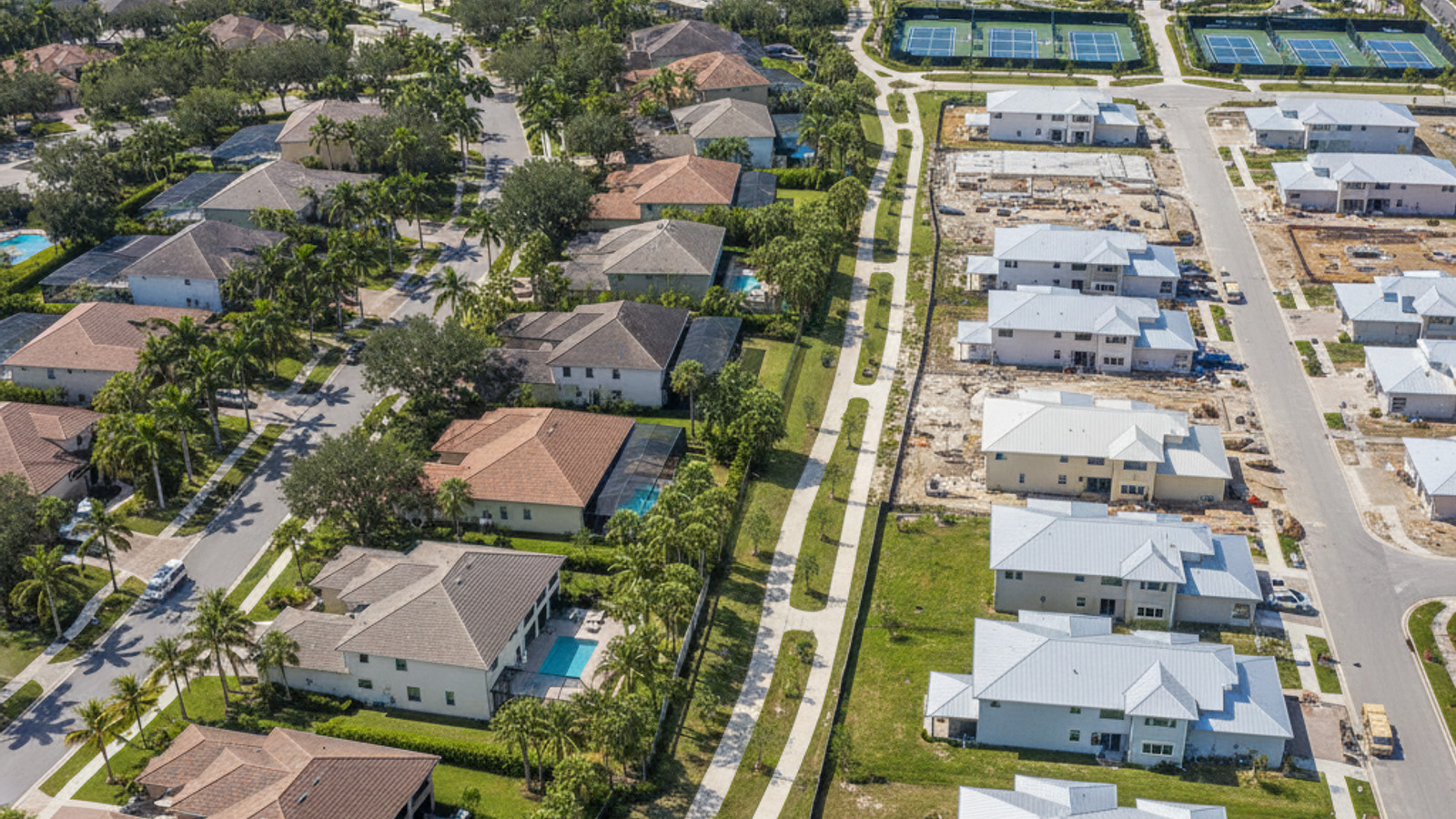
The median sale price for homes in Riverland recently hit roughly $517,000, down sharply from a year earlier. Sellers in this Port St. Lucie, FL community are working with a market where homes sit for a median of 88 days. Buyers have choices, and your initial asking price largely determines whether your home sells quickly or ages on the portals. Homeowners preparing to sell a home in Riverland can review our breakdown of the steps.
Setting the right price means ignoring the national headlines and focusing on what buyers paid in your specific Valencia neighborhood. A well-supported number attracts buyers. Guessing leads to extended market times and price cuts that show up in the listing history forever.
Key takeaway
Price your Riverland home at what comparable homes in your Valencia community sold for in the last 90 days, adjusted down for this year's price decline, rather than underpricing for a bidding war or overpricing to leave room. Only about 2 of the last 41 sales closed above asking, meaning the market rarely bids up a low price. If you need a faster sale, list just under the nearest search price bracket instead of cutting deeper.
Who this guide is for
You're preparing to list a home in Riverland and need to settle on an asking price that sells within your timeline without leaving money on the table.
The 2026 market: why pricing at recent sales works
In Riverland, roughly 2 of the last 41 sales closed above asking. The median sale landed at 97.3% of the list price after 88 days on the market.
Those two numbers tell you most of what you need to know about the current environment. Both standard pricing extremes fail here: underpricing rarely starts a bidding war, and padding your price to leave room for negotiation just ages the listing.
Redfin defines the average sale-to-list price ratio as a measurement of how close a home's final sale price was to its final list price during a given period. A ratio of 99% means a home sold for 1% under list price. At that median ratio, a home listed at $530,000 typically closes about $14,300 under asking, so plan for a modest negotiation gap rather than building in excessive cushion.
The area currently has 5.4 months of supply, which sits right on the edge of Florida Realtors' definition of a balanced market. Florida Realtors states that the benchmark for a balanced market, favoring neither buyer nor seller, is 5.5 months of inventory. Because buyers have time and real alternatives, your price has to make sense on day one.
Which pricing strategy fits your sale?
With 71 active listings competing for buyers in Riverland, your timeline is the first thing to sort out. Speed or maximum return: you need to decide which matters more before you pick a number.
The right strategy also depends on your home's condition and your financial needs. A few baseline questions help narrow the field.
- Do you need to close by a fixed date, for example because you've already committed to another home? If so, read "Pricing to a search price bracket" first, then "How big a price cut to make."
- Does your home's floor plan, collection, and condition closely match recent sales in your Valencia community? If yes, price at the comps using Steps 1 and 2 below.
- Is GL Homes currently selling a similar floor plan in a newer phase? If yes, Step 3 matters more than any other section, because a buyer will compare your price directly against a new build and its incentives.
- Does a comp-based price clear the amount you need after your mortgage payoff and selling costs? Get your current mortgage payoff figure from your lender before deciding whether a comp-based price meets your net.
Pricing to sell faster
The median Riverland home takes 88 days to sell, so listing to sell faster means aiming to beat that local timeline. This approach makes sense when you have a hard moving deadline or want to avoid carrying costs on a vacant property.
You give up the chance to test the upper limits of your home's value in exchange for a quicker closing. The goal is to position the property as the clear best value among similar active listings.
Pricing below market to draw multiple offers
The bidding-war tactic involves listing under the home's market value, hoping for competition, and relying on buyers bidding the price back up. It only works when several buyers want the same home at the exact same time.
Riverland's record shows that rarely happens. Only about 2 of the area's last 41 home sales closed above asking. Bidding wars are the exception, not the rule, and the downside is significant: if the second offer never arrives, your low price becomes the starting point that the one interested buyer negotiates down from.
Pricing to a search price bracket
Riverland's median sale price sits at roughly $517,005, just above a common buyer search cutoff. Homes valued near that cutoff face a real choice about how they appear in online portals.
A home whose comps support about $505,000 listed at $499,900 appears in "under $500,000" searches. The same home at $509,900 does not. If you want a faster sale and your comps support a value just above that threshold, bracket pricing is worth considering.
Contrast that with a home whose comps support $520,000. Dropping to $499,900 gives away about $20,000 before negotiation even starts. Check the price filter steps on the major portals for your bracket before choosing a number, and be clear-eyed about what you're trading away: bracket pricing only pays when your value is already near the line. Drop well below your comps to reach a bracket and you've cut your own price before any buyer asked.
Pricing to hold out for more
At the current pace, about 14 Riverland homes sell a month while roughly 70 sit listed. Strategies that aim above the comparable sales require patience and a willingness to sit on the market longer than the 88-day median.
Buyers compare every Riverland listing with dozens of others. An inflated price mostly makes the competition look like a better deal, so you have to justify every extra dollar with tangible features or accept the risk of sitting unsold.
Pricing high to leave room to negotiate
Sellers often want to pad the asking price to ensure they have room to come down during negotiations. The problem is that a listing priced above its comps is effectively helping the better-priced ones sell first.
The typical negotiation gap is modest, as the median sale-to-list ratio shows. A padded price simply prevents buyers from making an offer at all. And every reduction you make later shows in the listing's price history on the portals, where buyers read a string of cuts as permission to offer low.
Pricing for upgrades, views, and homesite
A premium for a preserve or lake view, an extended lanai, a pool, or a redone kitchen holds up only when you can point to a recent sale with the same feature that sold for more. If you want to charge more for a view, lanai, pool, or major upgrade, start with pricing for upgrades, views, and homesite.
Document your improvements with a list of upgrades, dates, and receipts. A buyer's appraisal will test your premium, and the evidence has to be solid, because if the buyer is financing, the lender lends against the appraisal. When the appraiser can't find a sale that supports your premium, you either cut the price or the buyer has to cover the gap in cash.
How to set your list price from sold comps
The most reliable pricing strategy in Riverland is to base your number on the 41 single-family homes that sold in the 90 days ending September 30, 2026. If you want the best price when your home closely matches recent sales in your Valencia community, start here.
With only about 2 of 41 recent sales closing above asking and a modest median gap to list, a well-supported price is what buyers pay. Padding it or undercutting it both cost you money and time.
Step 1: Pull recent sales in your Valencia community
Start with closed sales from the last 90 days in your own Valencia community and, ideally, your own collection or floor plan. Riverland's recent sales are split across Valencia Cay, Valencia Grove, Valencia Walk, and Valencia Parc, so exact matches are few.
If you can't find enough sales, widen your search to six months, then adjust the older sales in the next step. You can confirm recorded sale prices with the St. Lucie County Property Appraiser, which provides an online search tool to retrieve recorded sale prices and dates for individual parcels county-wide.
Compare each comp's original list price with its final list price. A comp that sold after cuts tells you exactly where the market pushed back. Ask whether your comps sold to cash or financed buyers, because financed sales passed an appraisal.
With 41 sales spread across several communities, you may find only a handful of close matches. Each one needs adjusting, so the result is a range, not an exact number.
Step 2: Adjust older sales for falling prices
The median sale price in Riverland fell 7.7% year over year. A matching home that sold for $560,000 a year ago, adjusted by that year-over-year decline, points to a value of about $516,900 today.
A seller anchored to a neighbor's price from last year will list too high. The downside of any blanket adjustment is that the median shift also reflects which homes happened to sell during that period. One percentage applied across the board can over- or under-correct a specific floor plan.
Step 3: Compare your home with active listings and new construction
Your sold comps set the value. Active listings and GL Homes' newer phases set what a buyer sees right next to you. If you're selling a floor plan that GL Homes is still building in a newer phase, this step matters immensely.
List the active homes in your size and plan, noting which went under contract fastest and at what price. Then compare against current GL Homes base prices and incentives in Valencia Parc and Valencia Vista. Your price has to reflect what a finished resale offers that a new build doesn't: the home is finished, planted and grown in, furnished with window treatments, and there's no build wait.
Confirm current GL Homes base prices and incentives with the sales center before pricing against new construction, since they change. When a builder is offering incentives, you may need to match them with seller concessions, and concessions come straight out of your net proceeds.
Step 4: Check your price per square foot
The median price per square foot in Riverland is $288. Use it as a sanity check, not a standalone pricing method.
An 1,800-square-foot home multiplied by that median equals $518,400. If your comp-based number lands far from that figure, find out why, whether due to a view, lot, condition, or collection, before you list. Larger homes usually carry a lower per-foot price, so the median fits mid-size plans best. The figure also blends villas and larger single-family plans, meaning a compact villa and a large estate home will each sit well away from it for reasons that have nothing to do with being over- or underpriced.
When and how to cut your price
The median Riverland home took 88 days to sell recently, and a slow first few weeks alone isn't proof of a pricing problem. Buyers take their time in a market with 5.4 months of supply. That said, you need a contingency plan in case the market rejects your initial number, and monitoring buyer behavior is how you decide if and when to adjust.
Signs your price is too high
Watch for showings with no second visits, feedback that mentions price, and newer listings at lower prices going under contract before yours. If buyers tour the property but write offers elsewhere, your price is likely the obstacle.
Once your listing passes the local median with few showings, buyers start to assume something is wrong with the house, not just the price. That's a hard perception to recover from.
How big a price cut to make
Size the cut so it changes who sees the home and how it compares to the active inventory. Aim to cross into the next search bracket or go below the specific competing listing you keep losing to.
One decisive cut works better than several small ones. Small, repeated drops fail to generate new interest and signal to buyers that you'll keep going. Every cut is also permanent in the listing history, and buyers will see the original price and may treat the gap as proof you'll go lower.
Costs and steps that affect your list price
A home selling at the median price carries thousands of dollars in real estate commissions and seller closing costs, so calculate those deductions carefully when working out the net from a comp-based price.
Property valuation methods explain how appraisers and portals estimate your home's worth before listing. You'll also need to complete seller disclosures to document the property's condition for buyers. Staging helps optimize the presentation before listing photos are taken, and buyers weigh HOA fees and property taxes carefully, because a buyer's property tax assessment resets after purchase and affects what they can pay monthly. Ask the HOA for current dues and any resale approval or contribution fees so you can share them with buyers upfront.
Comparing a traditional listing against cash offers helps clarify your options, and tracking the broader housing market trend keeps your expectations grounded.
At a glance
- Median sale price: $517,005 (all homes, 90 days ending Sept. 30, 2026)
- Change from a year earlier: -7.7% (all homes, 90 days ending Sept. 30, 2026)
- Homes sold: 41, all single-family (90 days ending Sept. 30, 2026)
- Median days on market: 88 (all homes, 90 days ending Sept. 30, 2026)
- Median sale-to-list ratio: 97.3% (all homes, 90 days ending Sept. 30, 2026)
- Share of homes sold above list price: 5% (all homes, 90 days ending Sept. 30, 2026)
- Months of supply: 5.4 (all homes, 90 days ending Sept. 30, 2026)
- Active listings: 71 (all homes, 90 days ending Sept. 30, 2026)
- Median price per square foot: $288 (all homes, 90 days ending Sept. 30, 2026)
- Source line: Redfin data via Redfin Data Center.
FAQ
Are Florida home prices expected to drop?
Riverland's median sale price is already below last year's level, pointing to a local decline. Per Florida Realtors' September 2026 statewide housing report, the single-family median sale price rose 1.2% year-over-year to $415,000, marking the seventh consecutive month of year-over-year increases, while single-family closed sales declined 3.5% year over year. Sellers should price to recent sales, not to last year's numbers or to an expected rebound.
What are the four main types of pricing strategies?
The classic marketing types are penetration, skimming, premium, and value-based pricing. Penetration maps to pricing below market to draw multiple offers, while skimming maps to pricing high to leave room to negotiate. Premium pricing aligns with charging more for upgrades and views, and value-based pricing means setting your list price at the sold comps.