


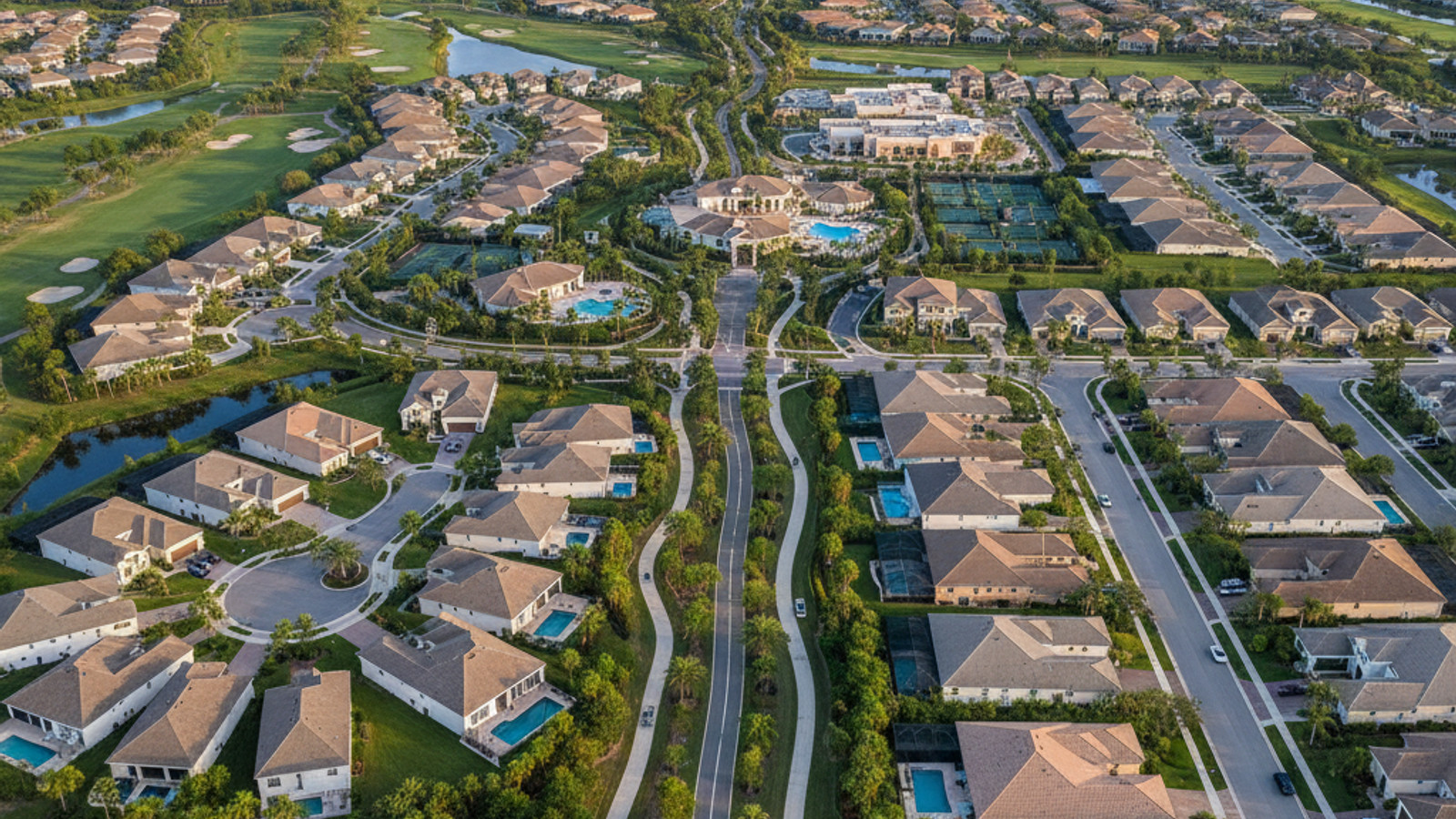
Riverland is a master-planned community on the west side of Port St. Lucie, FL, approved for up to 11,700 homes across nearly 4,000 acres. Built by GL Homes, it centers on the 55+ Valencia neighborhoods and a massive network of shared amenities.
Buyers moving to Riverland face a choice between buying a resale home in an established phase or waiting for new construction to finish. Understanding the current market pace and Florida's specific residency steps helps you organize a cross-state move without rushing. Reviewing the pros and cons of living in Riverland can help you decide if the community fits your plans.
Key takeaway
Start your Riverland search with resale homes in the established Valencia neighborhoods. Homes are selling after a median 88 days, giving you time to scout, compare, and negotiate repairs and closing terms instead of rushing. If you prefer a brand-new home and can wait for it to be built, Valencia Parc is the alternative.
Who this guide is for
You are planning a move to Riverland in Port St. Lucie and deciding whether to buy resale or build new, which Valencia neighborhood to tour first, and how to time the move.
Is now a good time to move to Riverland?
Riverland in 2026 rewards a slow, scouted move rather than a fast one. Median sale prices are down roughly 7.7% year over year, homes are sitting a median 88 days, and you have real time to tour across the Valencia neighborhoods and line up insurance and HOA approval before committing.
That said, sales still close near list price. Your negotiating power is in time, repairs, and closing terms, not a deep discount. Well-priced homes still sell close to asking, so the breathing room is genuine without being unlimited. You can review the full trend on our housing market page and check the exact figures in the "At a glance" section below.
Riverland home prices are down from last year
The median sale price recently settled around $517,000, down from the previous year. Sellers who bought or priced at the peak are adjusting their expectations, which means you're not chasing a rising market while simultaneously trying to sell your current home.
The downside is real, though. A falling median means the home you buy may not appreciate quickly in the near term. Budget as if you'll hold the property for years, and review our affordability guide to see what monthly payment fits your situation.
How much inventory is for sale
Months of supply measures how long it would take to sell every active listing at today's pace. Riverland currently sits at about 5.4 months of supply, with roughly 71 homes listed. At the current sales pace, that's more than five months of inventory, which gives you room to tour several properties across different neighborhoods over more than one visit.
The catch is that inventory isn't spread evenly across the Valencia neighborhoods. The specific floor plan or lot type you want may have only one or two listings available at any given time.
How much room there is to negotiate
A median 97.3% sale-to-list ratio means homes close about 2.7% under asking, which works out to roughly $14,000 on a home listed near the median price. Only about 1 in 20 Riverland homes sold above asking in the latest 90-day window.
The negotiating room is real but modest. Ask for repairs, a closing-cost credit, or a closing date that matches your move rather than swinging for a deep price cut. An aggressive offer on the best listing can lose it to the next buyer.
Where is Riverland in Port St. Lucie?
City of Port St. Lucie planning records place the Riverland master development area south of Discovery Way, west of Community Boulevard, and east of Range Line Road. Community Boulevard serves as the main arterial road connecting the development to the rest of the city, and the community sits just west of the Tradition master-planned area.
For details on daily travel, check our getting-around and commute pages. County and ZIP code specifics are covered in the FAQ section below.
Riverland neighborhoods: resale or build new
The Valencia neighborhoods inside Riverland are age-restricted communities, and your primary decision is whether to buy an existing home or build a new one. Resale-led neighborhoods let you move in sooner and put the current market's negotiating room to work. The neighborhood where the builder is still selling gets you new construction, at the cost of waiting and accepting builder-set pricing.
Check our best-neighborhoods page for a full comparison across the area.
Valencia Cay
Builder sales in Valencia Cay have closed out, so buying here is a resale transaction. That's where the current negotiating room applies, and you can move in as soon as a standard closing allows.
Your choice is limited to whatever happens to be listed today. If you need a specific floor plan or lot, expect to wait or compromise, and always ask the HOA for current dues before you tour.
Valencia Grove
Like Valencia Cay, Valencia Grove is fully sold out of builder inventory. You're buying resale, and resale asking prices here are set against what the builder is offering on new homes in the newer phases nearby. See our Cay-vs-Grove and Grove-vs-Parc comparison pages for a detailed breakdown.
What you give up is the builder warranty. Check current builder pricing and incentives in the newer phases before paying a premium for a lightly used home in Valencia Grove.
Valencia Walk
Valencia Walk opened after the sell-out of Cay and Grove. Data shows resale activity in these newer phases keeps ongoing costs straightforward, but verify the specific assessments on any lot you're considering.
HOA dues still apply and cover the clubhouse and grounds. Ask for the current dues and what they include before comparing it with neighboring communities.
Valencia Parc
Valencia Parc is an active new-construction phase, offering brand-new homes with your choice of floor plan. GL Homes recently listed early move-in inventory, including an Areca floorplan available for November 2026. This is the option if you can wait for construction to finish.
You're buying on the builder's schedule, not yours. Get the estimated completion date in writing, and expect ongoing construction traffic and noise while later phases build out around you.
What it costs to own a home in Riverland
Monthly costs go well beyond the mortgage payment, and our cost-of-living page breaks down the broader area expenses. Inside Riverland, community fees and closing costs make up the bulk of your carrying and upfront expenses. Property taxes also factor into your budget, which we cover under the homestead exemption step below.
HOA dues
Every Valencia neighborhood has a homeowners association. Dues and what they cover differ by neighborhood, and our HOA page breaks them down in detail.
Dues can change after you buy. Ask the HOA for the current amount, the latest budget, and any planned special assessments before your inspection period ends.
CDD assessments
A Community Development District assessment pays for neighborhood infrastructure and appears on the property tax bill rather than as an HOA invoice, so it's easy to miss when you're comparing monthly dues across communities.
The amount depends on the specific parcel. Look up that home's non-ad valorem assessments on the St. Lucie County Tax Collector's site before you make an offer.
Buyer closing costs
Florida buyers pay title, lender, and recording costs at closing. Our buyer closing costs breakdown covers them in detail, and a seller credit toward these costs is a realistic ask in the current market.
A seller credit lowers your cash at closing but is capped by your loan program. Confirm the limit with your lender before asking for one.
How to plan your move to Riverland
The current median of 88 days on market means you have time to organize your move in stages. You can work through these steps before committing to a purchase, which helps you avoid the most common pitfalls of a cross-state relocation.
If you need help scheduling scouting tours, reach out and we can set up a visit.
Visit before you list your current home
Use the slower pace to scout first. Tour two or three Valencia neighborhoods and their clubhouses on one trip, then list your current home once you have a shortlist. Check our things-to-do page for help planning the visit.
Your own home may sell slower or faster than you expect. Check a contingency or rent-back option with your lender before you end up carrying two mortgages.
Get insurance quotes before you make an offer
Homeowners and flood insurance quotes can shift the monthly cost more than a small price difference. Get quotes on a specific address, check its FEMA flood zone, and factor that into your budget before you go under contract. Florida insurers typically stop writing new policies when a named storm threatens, which can push back a closing. Our safety page covers flood zones in more detail.
A quote is not a bound policy. Make sure your contract's timeline leaves room to bind coverage, especially between June and November.
Start the HOA application and age verification early
Age-restricted communities verify occupancy under the federal housing-for-older-persons exemption, and the HOA may require an application before closing. Our 55+ options page covers these community types.
Approval takes time and comes with its own rules on guests, leasing, and pets. Ask the HOA for its application timeline and full rules before you sign, not after.
Time the move around hurricane season
Atlantic hurricane season officially runs June 1 through November 30. A move outside that window avoids storm-related closing and moving delays. See our weather page for climate detail.
Moving outside hurricane season doesn't remove the risk for the house itself. You still need a storm plan and coverage in place from day one.
Check the move-in rules for trucks and gate access
Gated communities typically register vendors and may limit moving-truck hours or sizes. Ask the HOA or management company for the gate and truck rules in writing, then pass them to your moving company before they load the truck.
A mover turned away at the gate costs you a rescheduled day.
Setting up after you move to Port St. Lucie
Establishing residency in Florida comes with specific deadlines and paperwork. County and state offices handle the major administrative steps, and tackling them early gets you the tax benefits of being a primary resident while keeping your vehicles street-legal.
File for the homestead exemption
If the home is your permanent residence, file with the St. Lucie County Property Appraiser. The St. Lucie County Tax Collector notes that March 1 is the deadline to file new homestead exemptions. Once homesteaded, Florida's Save Our Homes rule caps how much the assessed value can rise each year at 3%. Our property tax page explains the math and the assessment reset on purchase.
Your first tax bill is based on the purchase-reset value, not the seller's capped bill. Missing the March 1 filing deadline costs you the exemption for that year.
Switch your driver's license and vehicle registration
New Florida residents have a set window to get a Florida driver's license and register their vehicles. You can book appointments through the St. Lucie County Tax Collector. Bring original identity and residency documents in person, and pack them in your carry-on rather than the moving truck so they don't get lost in transit.
Set up electric, water and sewer service
Schedule your utility start dates for closing day. Confirm with the seller or the HOA which electric, water, and sewer providers serve your exact address before closing week, and call early. New accounts may require a deposit or ID verification, which can delay service if you wait until the last minute.
Daily life in Riverland
The master plan connects the different neighborhoods through shared pathways and central facilities. GL Homes designed the area to keep daily recreation inside the community footprint, and understanding how these amenities link together helps you decide which specific lot or phase makes the most sense for your routine.
The Paseo greenway
The Paseo and greenways provide over 5 miles of traffic-free pathways connecting multiple city parks and the town center. Residents can use the Paseo by golf cart, bike, or on foot.
How useful it is depends on your lot. Check the actual distance from a home to the nearest Paseo access point when you tour.
Clubhouses and amenity centers
The community features a 24-acre Sports and Racquet Club with a 51,000-square-foot Wellness and Fitness Center, plus a 5-acre Arts and Culture Center. These are shared amenities connected to all Riverland neighborhoods via the Paseo, rather than being exclusive to a single sub-community.
Access and any separate charges are set by your community's documents. Ask the HOA which facilities your dues cover before assuming they're included.
Shopping and the planned town center
The City Council approved rezoning for a 35-acre, Publix-anchored commercial project within Riverland, west of I-95 at Community Boulevard, and GL Homes is breaking ground on this retail and commercial center. Right now, most major grocery and retail errands happen outside the development.
Planned is not built. Until it opens, assume most errands mean driving out of Riverland, and don't pay a premium for a lot based on a future retail opening.
Getting to the beach, airports and I-95
Riverland sits on the city's west side, so trips to the coast require a drive across town or down the highway. Our commute and getting-around pages cover the specific routes and travel times. If that distance matters to you, compare coastal options on our Riverland vs. Jensen Beach and vs. Stuart pages.
How to narrow your Riverland shortlist
If you need to be moved in within a few months, focus on the resale-led neighborhoods: Valencia Cay and Valencia Grove. You can use the negotiating room detailed in the market section above. If you want a brand-new home and can wait for construction, go straight to the Valencia Parc profile and our new-developments page.
When ongoing costs are the priority, always check the property tax bill for a CDD assessment on top of HOA dues. You can weigh the neighborhoods head-to-head on our Valencia Cay vs. Valencia Walk, Valencia Walk vs. Valencia Parc, and Valencia Cay vs. Valencia Parc pages. When you're ready to tour the shortlisted neighborhoods, let us know and we can set up the appointments.
At a glance
- All homes, median sale price: $517,005 (90 days ending Sept. 30, 2026)
- All homes, change in median sale price vs. a year earlier: -7.7% (90 days ending Sept. 30, 2026)
- Single-family homes, median sale price: $517,064 (90 days ending Sept. 30, 2026)
- All homes, homes sold: 41 (90 days ending Sept. 30, 2026)
- All homes, median days on market: 88 (90 days ending Sept. 30, 2026)
- All homes, median sale-to-list ratio: 97.3% (90 days ending Sept. 30, 2026)
- All homes, share sold above list price: 5% (90 days ending Sept. 30, 2026)
- All homes, months of supply: 5.4 (90 days ending Sept. 30, 2026)
- All homes, homes for sale: 71 (90 days ending Sept. 30, 2026)
- All homes, median price per square foot: $288 (90 days ending Sept. 30, 2026)
- Source line under the list: Redfin data via market data, Riverland, Port St. Lucie
FAQ
What county is Riverland, FL in?
Riverland is located in the City of Port St. Lucie, which is in St. Lucie County. County offices, such as the property appraiser and tax collector, are where new residents file their homestead and title paperwork.
What is the ZIP code for Riverland, FL?
Riverland and its Valencia-branded neighborhoods use the Port St. Lucie 34987 ZIP code. Buyers should confirm the ZIP code on a specific listing, as large master plans can sometimes span more than one boundary.
Is Riverland, FL safe?
Official crime data for the area comes from the Port St. Lucie Police Department and FBI reporting. Flood risk is determined by checking a specific address on FEMA flood maps. You can review both factors and the methodology on our safety page.