Real Estate News & Market Trends on Florida's Treasure Coast

You’ll find our blog to be a wealth of information, covering everything from local market statistics and home values to community happenings. We feature topics relevant to the Treasure Coast of Florida which includes, Stuart, Port St Lucie, Vero Beach, Palm City & Jensen Beach. That’s because we care about the community and want to help you find your place in it. Please reach out if you have any questions at all. We’d love to talk with you!

March 10, 2020

Equity Gain Growing in Nearly Every State

Equity Gain Growing in Nearly Every State | MyKCM

Rising home prices have been in the news a lot lately, and much of the focus is on whether they’re accelerating too quickly and how sustainable the growth in prices really is. One of the often-overlooked benefits of rising prices, however, is the impact they have on a homeowner’s equity position.

Home equity is defined as the difference between a home's fair market value and the outstanding balance of all liens on the property. While homeowners pay down their mortgages, the amount of equity they have in their homes climbs each time the value increases.

Today, the number of homeowners that currently have significant equity in their homes is growing. According to the Census Bureau, 38% of all homes in the country are mortgage-free.  In a home equity studyATTOM Data Solutions revealed that of the 54.5 million homes with a mortgage, 26.7% of them have at least 50% equity. That number has been increasing over the last eight years.

CoreLogic also notes:

“…the average homeowner gained approximately $5,300 in equity during the past year.”

The map below shows a breakdown of the increasing equity gain across the country, painting a clear picture that home equity is growing in nearly every state.Equity Gain Growing in Nearly Every State | MyKCM

Bottom Line

This may be the year to take advantage of your home equity by applying it forward, either as you downsize or as you move up to a new home.

March 4, 2020

Real Estate Is Soaring, But Not Like 2008

Real Estate Is Soaring, But Not Like 2008 | MyKCM

Unlike last year, the residential real estate market kicked off 2020 with a bang! In their latest Monthly Mortgage MonitorBlack Knight proclaimed:

“The housing market is heating entering 2020 and recent rate declines could continue that trend, a sharp contrast to the strong cooling that was seen at this same time last year.”

Zillow revealed they’re also seeing a robust beginning to the year. Jeff Tucker, Zillow Economist, said:

"Our first look at 2020 data suggests that we could see the most competitive home shopping season in years, as buyers are already competing over…homes for sale.”

Buying demand is very strong. The latest Showing Index from ShowingTime reported a 20.2% year-over-year increase in purchaser traffic across the country, the sixth consecutive month of nationwide growth, and the largest increase in the history of the index.

The even better news is that buyers are not just looking. The latest Existing Home Sales Report from the National Association of Realtors (NAR) showed that closed sales increased 9.6% from a year ago.

This increase in overall activity has caused Zelman & Associates to increase their projection for home price appreciation in 2020 from 3.7% to 4.7%.

Are we headed for another housing crash like we had last decade?

Whenever price appreciation begins to accelerate, the fear of the last housing boom and bust creeps into the minds of the American population. The pain felt during the last housing crash scarred us deeply, and understandably so. The crash led us into the Great Recession of 2008.

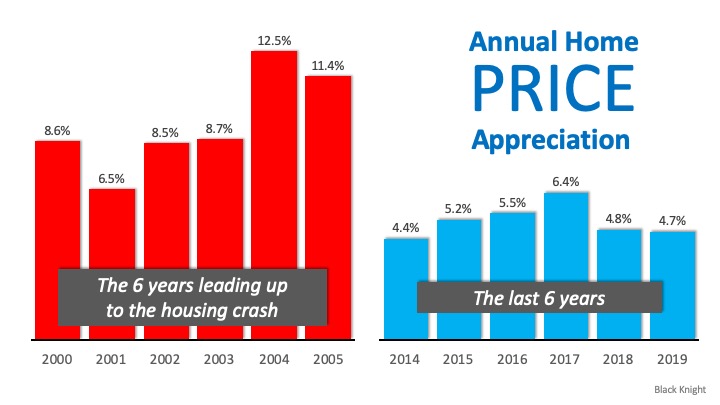
If we take a closer look, however, we can see the current situation is nothing like it was in the last decade. As an example, let’s look at price appreciation for the six years prior to the last boom (2006) and compare it to the last six years:Real Estate Is Soaring, But Not Like 2008 | MyKCMThere’s a stark difference between these two periods of time. Normal appreciation is 3.6%, so while current appreciation is higher than the historic norm, it’s certainly not accelerating beyond control as it did leading up to the housing crash.
Today, the strength of the housing market is actually helping prevent a setback in the overall economy. In a recent post, Odeta Kushi, Deputy Chief Economist for First American explained:

“While the housing crisis is still fresh on the minds of many, and was the catalyst of the Great Recession, the U.S. housing market has weathered all other recessions since 1980. With the exception of the Great Recession, house price appreciation hardly skipped a beat and year-over-year existing-home sales growth barely declined in all the other previous recessions in the last 40 years…In 2020, we argue the housing market is more likely poised to help stave off recession than fall victim to it.”

Bottom Line

The year has started off very nicely for the residential housing market. If you’re thinking of buying or selling, now may be the time to get together to discuss your options.

March 3, 2020

How Interest Rates Can Impact Your Monthly Housing Payments

How Interest Rates Can Impact Your Monthly Housing Payments | MyKCM

Spring is right around the corner, so flowers are starting to bloom, and many potential homebuyers are getting ready to step into the market. If you’re thinking of buying this season, here’s how mortgage interest rates are working in your favor.

Freddie Mac explains:

If you're in the market to buy a home, today's average mortgage rates are something to celebrate compared to almost any year since 1971…

Mortgage rates change frequently. Over the last 45 years, they have ranged from a high of 18.63% (1981) to a low of 3.31% (2012). While it's not likely that the average 30-year fixed mortgage rate will return to its record low, the current average rate of 3.45% is pretty close — all to your advantage.”

To put this in perspective, the following chart from the same article shows how average mortgage rates by decade have impacted the approximate monthly payment of a $200,000 home over time:How Interest Rates Can Impact Your Monthly Housing Payments | MyKCMClearly, when rates are low – like they are today – qualified buyers can benefit significantly over time.

Keep in mind, if interest rates go up, this can push many potential homebuyers out of the market. The National Association of Home Builders (NAHB) notes:

“Prospective home buyers are also adversely affected when interest rates rise. NAHB’s priced-out estimates show that, depending on the starting rate, a quarter-point increase in the rate of 3.75% on a 30-year fixed rate mortgage can price over 1.3 million U.S. households out of the market for the median-priced new home.”

Bottom Line

You certainly don’t want to be priced out of the market this year, and waiting may mean a significant change in your potential mortgage payment should rates start to rise. If your financial situation allows, now may be a great time to lock in at a low mortgage rate to benefit greatly over the lifetime of your loan.

Feb. 28, 2020

How Trusted Professionals Make Homebuying Easier to Understand

How Trusted Professionals Make Homebuying Easier to Understand | MyKCM

In the spring, many excited buyers get ready to enter the housing market. Others continue dreaming about the homes they’d like to buy. The truth is, many potential buyers continue to dream longer than they need to, simply because they’re confused about the homebuying process. Thankfully, working with a trusted real estate professional can help ease those concerns and make the process to homeownership much easier to understand.

A recent survey conducted by Ipson and Freddie Mac reveals the confidence level of Gen Z and Millennial buyers regarding the homebuying process. The graph below shows the breakdown of the top results, clearly indicating there’s a significant portion of younger buyers who are not yet confident with some of the steps in the homebuying process.How Trusted Professionals Make Homebuying Easier to Understand | MyKCMBetween the homebuying process and the mortgage process, there are 230 possible steps in the transaction. With trusted professionals on your side, you certainly don’t have to know them all to have a successful experience.

There are many reasons why these steps can change as you move through each one. Depending on your personal circumstances, the term or your mortgage, and the type of loan you use, the path you take may need to vary. That’s why guidance and support from the experts is key.

In addition to the process itself, respondents in the survey definitely expressed concerns about understanding the types of loans available. Here are just a few of the basic loans to consider. Be sure to speak with your lender about the specifics of what will work best for you:

  • FHA: Loans guaranteed by the Federal Housing Administration for first-time buyers. They generally enable qualified borrowers to enter the housing market with a lower down payment.
  • Conventional: Loans that usually require a larger down payment. Repeat buyers usually use these types of loans since they have an established credit history as well as more money from the sale of their previous home (called equity) for a bigger down payment.
  • VA: Loans available for Veterans of the U.S. Armed Forces and their spouses. They are guaranteed by the Department of Veteran Affairs.
  • USDA: Loans for those living in rural and suburban areas. A qualified lender can issue a USDA home loan, and they are guaranteed by the United States Department of Agriculture (USDA).

Interest rates also popped up as a common area of confusion among Gen Z and Millennial respondents in the survey. With today’s rates hovering at near historic lows, it’s a fantastic time for buyers to get more house for their money in the current market. Why? When mortgage rates are this low and wages are increasing as they are today, overall affordability increases, enabling home buyers to stretch their mortgage dollars further. It’s just another area where a trusted professional can help simplify the process and give guidance along the way.

Bottom Line

There are many possible steps in a real estate transaction, but they don’t have to be confusing. To understand your best course of action, let’s get together today to ensure you have a trusted advisor who will help you feel confident and informed at every turn.

Posted in Buying, Market Updates
Feb. 28, 2020

The #1 Misconception in the Homebuying Process

The #1 Misconception in the Homebuying Process | MyKCM

After over a year of moderating home prices, it appears home value appreciation is about to reaccelerate. Skylar Olsen, Director of Economic Research at Zillow, explained in a recent article:

 “A year ago, a combination of a government shutdown, stock market slump and mortgage rate spike caused a long-anticipated inventory rise. That supposed boom turned out to be a short-lived mirage as buyers came back into the market and more than erased the inventory gains. As a natural reaction, the recent slowdown in home values looks like it's set to reverse back.”

CoreLogic, in their January 2020 Market Pulse Report, agrees with Olsen, projecting home value appreciation in all fifty states this year. Here’s the breakdown:

  • 21 states appreciating 5% or more
  • 26 states appreciating between 3-5%
  • Only 3 states appreciating less than 3%

The Misconception

Many believe when real estate values are increasing, owning a home becomes less affordable. That misconception is not necessarily true.

In most cases, homes are purchased with a mortgage. The current mortgage rate is a major component of the affordability equation. Mortgage rates have fallen by almost a full percentage point since this time last year.

Another major piece of the equation is a buyer’s income. The median family income has risen by 5% over the last year, contributing to the affordability factor.

Black Knight, in their latest Mortgage Monitor, addressed this exact issue:

 “Despite the average home price increasing by nearly $13,000 from just over a year ago, the monthly mortgage payment required to buy that same home has actually dropped by 10% over that same span due to falling interest rates…

Put another way, prospective homebuyers can now purchase a $48K more expensive home than a year ago while still paying the same in principal and interest, a 16% increase in buying power.”

Bottom Line

If you’re thinking about purchasing a home, realize that homes are still affordable even though prices are increasing. As the Black Knight report concluded:

“Even with home price growth accelerating, today’s low-interest-rate environment has made home affordability the best it’s been since early 2018.”

Feb. 28, 2020

10 Steps to Buying a Home [INFOGRAPHIC]

10 Steps to Buying a Home [INFOGRAPHIC] | MyKCM

Some Highlights:

  • If you’re thinking of buying a home and you’re not sure where to start, you’re not alone.
  • Here’s a guide with 10 simple steps to follow in the homebuying process.
  • Be sure to work with a trusted real estate professional to find out the specifics of what to do in your local area.
Feb. 27, 2020

How Much “Housing Wealth” Can You Build in a Decade?

How Much “Housing Wealth” Can You Build in a Decade? | MyKCM

Earlier this month, the National Association of Realtors (NAR) released a special study titled Single-Family Home Price Gains by Years of Tenure. The study estimates median home price appreciation over the last 30 years based on the length of homeownership.

Below are three graphs depicting the most important data revealed in the study.

How much have home prices increased?

One of the first measures of the financial benefits of homeownership is the net worth (in the form of equity) an owner can build over time. The study showed the average increase in home values based on how long homeowners stayed in a home.
How Much “Housing Wealth” Can You Build in a Decade? | MyKCM

What was the percentage of appreciation?

Another way to look at this is by the percentage increase in value over time, called appreciation:How Much “Housing Wealth” Can You Build in a Decade? | MyKCM

Was this appreciation consistent throughout the country?

Today, when we think of markets that have done well over the last decade, we have a tendency to think about San Francisco, San Diego, Seattle, and other West Coast cities. Though it is true the West Region showed the highest price growth over the last three decades, we can see how every region of the country did quite well in ten-year increments:How Much “Housing Wealth” Can You Build in a Decade? | MyKCMThis data validates the claim that homeownership is great for building wealth. The importance of this information was highlighted in the study’s first sentence:

“Homeownership is an important source of wealth creation, enabling current homeowners and succeeding generations to move up the economic ladder.”

Bottom Line

Homeownership has many financial and non-financial benefits. The accumulation of “housing wealth” through increased equity is a major one. If you’re thinking of buying a home for the first time or moving up to your dream home, the sooner you make the move, the sooner your net worth will begin to grow.

Posted in Housing Economy
Feb. 26, 2020

Thinking of Selling? Now May Be the Time.

Thinking of Selling? Now May Be the Time. | MyKCM

The housing market has started off much stronger this year than it did last year. Lower mortgage interest rates have been a driving factor in that change. The average 30-year rate in 2019, according to Freddie Mac, was 3.94%. Today that rate is closer to 3.5%.

The Census Bureau also just reported the highest homeownership rate since 2014 for people under 35. This is evidence that owning their own home is becoming more important to Millennials as they reach the age where marriage and children are part of their lives.

According to the latest Realtors Confidence Index Survey from the National Association of Realtors (NAR), buyer demand across the country is strong. That’s not the case, however, with seller demand, which remains weak throughout most of the nation. Here’s a breakdown by state:Thinking of Selling? Now May Be the Time. | MyKCMDemand for housing is high, but supply is extremely low. NAR also just reported that the actual number of homes currently for sale stands at 1.42 million, which is one of the lowest totals in almost three decades. Additionally, the ratio of homes for sale to the number purchased currently stands at 3.1 months of inventory. In a normal market, that number would be nearly double that at 6.0 months of inventory.

What does this mean for buyers and sellers?

Buyers need to remain patient in the search process. At the same time, buyers must be ready to act immediately once they find the right home.

Sellers may not want to wait until spring to put their houses on the market. With demand so high and supply so low, now is the perfect time to sell your house for the greatest dollar value and the least hassle.

Bottom Line

The real estate market is entering the year like a lion. There’s no indication it will lose that roar, assuming inventory continues to come to market.

Posted in Market Updates, Selling
Feb. 25, 2020

Epic Housing Shortage Being Reported

Epic Housing Shortage Being Reported | MyKCM

The Joint Center of Housing Studies (JCHS) at Harvard University recently released their 2017 State of the Nation’s Housing Study, and a recent blog from JCHS revealed some of the more surprising aspects of the study.

The first two revelations centered around the shortage of housing inventory currently available in both existing homes and new construction.

Regarding Existing Home Inventory:

“For the fourth year in a row, the inventory of homes for sale across the US not only failed to recover, but dropped yet again. At the end of 2016 there were historically low 1.65 million homes for sale nationwide, which at the current sales rate was just 3.6 months of supply - almost half of the 6.0 months level that is considered a balanced market.”

Regarding New Home Inventory:

“Markets nationwide are still feeling the effects of the deep and extended decline in housing construction. Over the past 10 years, just 9 million new housing units were completed and added to the housing stock. This was the lowest 10-year period on records dating back to the 1970s, and far below the 14 and 15 million units averaged over the 1980s and 1990s.”

Bottom Line

The biggest challenge in today’s market is getting current homeowners and builders to realize the opportunity they have to maximize profit by selling and/or building NOW!!

Posted in Home Inventory
Feb. 6, 2020

No Matter What the Groundhog Says... You Should Sell Before Spring!


No Matter What the Groundhog Says... You Should Sell Before Spring!

No matter how soon the groundhog says spring is coming, don't wait to put your house on the market. Let's connect to explore the reasons why now is a great time to sell.